 by
by Introduction — The Light in the Shadows
In the world of cinema and visual culture, beauty is far from neutral. It is laden with meaning shaped by historical hierarchies of race, colonialism, patriarchy, and color bias — a phenomenon often called colorism. For centuries, global media industries have propagated narrow standards that implicitly valorize lighter skin tones while marginalizing deeper shades. When Lupita Nyong’o rose to international prominence in the 2010s, her presence on screen did not simply add another face to Hollywood’s roster — it challenged an entrenched visual hierarchy. Her ascendancy offered a counter‑narrative to long‑standing norms that equate beauty with paleness, reshaping not only how audiences see dark skin, but how people with dark skin see themselves.
Before Nyong’o’s arrival on the international stage, the appearance of dark‑skinned women as glamorous, central figures in mainstream cinema was rare. Representation either reduced such women to stereotypes or rendered them invisible altogether. This article charts how Nyong’o’s visibility — through film roles, public commentary, and cultural participation — sparked nuanced conversations about beauty, belonging, and self‑worth that rippled across continents and generations.
Through her story, we confront larger questions: What does it mean to see oneself reflected on the global screen? How does representation impact psychological self‑value and cultural esteem? And how can an individual’s visibility disrupt systemic bias?
1. Early Experiences with Colorism — The Personal Roots of a Public Mission
Despite coming from a family that valued inner character over outward conformity, Nyong’o’s own journey with her complexion was shaped by early encounters with color bias. Growing up, she observed that lighter skin often received preferential treatment — in subtle praise at school, and in explicit media messaging. In commercials she saw in Kenya, women with lighter skin were portrayed as more successful or desirable, reinforcing the idea that dark skin was a disadvantage. These images left emotional imprints, shaping her young self‑image in ways that were painful and deeply familiar to many who grow up in societies influenced by colonial aesthetics and globalized media standards.
In public talks and later in her children’s book Sulwe, Nyong’o has recounted moments of wishing to be lighter — even praying for a complexion change — before she learned to embrace her own dark skin as beautiful and powerful. This personal narrative resonates precisely because it echoes the lived experience of countless individuals raised in cultures where European beauty norms have long dominated.
2. “Invisible to Yourself” — A Claim That Cuts Deep
One of Nyong’o’s most frequently cited reflections on identity and representation comes from her insight that “if you turn on the television and you are not represented on that television, you become invisible to yourself.” This statement isn’t mere rhetoric — it encapsulates an essential psychological truth: when media consistently privileges certain bodies and erases others, it shapes the collective imagination of who is seen, acknowledged, and valued.
Historically, this invisibility has had real social consequences. A 2015 analysis of fashion magazines found that even when Black women appeared, they were disproportionately light‑skinned compared to the broader population — a visual bias that mirrors Hollywood casting patterns.
In this context, Nyong’o’s visibility — with her dark complexion and natural hair — contradicted decades of underrepresentation. Her public presence in roles, red carpets, magazine covers, and cultural discussions became a form of visual affirmation for those long excluded from dominant beauty narratives.
3. Breaking Hollywood’s Mold — From 12 Years a Slave to Marvel
Nyong’o’s breakout role as Patsey in 12 Years a Slave (2013), for which she won the Academy Award for Best Supporting Actress, was a moment that transcended any single performance. Though the film itself was tethered to the painful history of slavery — and not celebrated for its celebration of beauty — Nyong’o’s recognition sparked a broader cultural conversation about who gets to be valuable on screen. Her success challenged the assumption that dark‑skinned Black women could not be central figures in critically acclaimed cinema.
However, the industry’s response wasn’t immediately transformative. Following her Oscar win, Nyong’o revealed she was often offered roles that echoed her debut — confined to narratives of suffering and enslavement. Rather than settling into that typecasting, she consciously chose roles that expanded the diversity of stories told about Black lives, such as supporting parts in major franchises like Star Wars and Black Panther, and later lead roles in diverse genres like Us and A Quiet Place.
Her choices reflect a strategic navigation of Hollywood — one that resists reductive depictions of Black experience while amplifying a broader mosaic of identities.
4. Beyond the Screen — Representation as Empowerment
Nyong’o has consistently reflected on the broader psychological impact of her visibility. In interviews and public speeches, she has spoken about hearing from young people who found in her a kind of mirror they had never had before — a reflection that validated their beauty, their aspirations, and their sense of worth.
When a young woman involved in the production of Queen of Katwe told her, “I’ve never had so many people call me beautiful until you showed up,” it crystallized how individual visibility can ripple outward, affirming identity in spaces that had historically been dismissive.
This isn’t a superficial emotional outcome; it has profound implications for how individuals relate to their own bodies and possibilities. Representation has been linked to enhanced self‑esteem and decreased internalization of bias — outcomes that echo in cultural critiques of media from every region of the world.
5. A Global Cultural Shift — Intersection of Local and Global Narratives
While Lupita’s impact is rooted in Western media imagery, its resonance is global. In many African, Asian, and Latin American societies, beauty is still framed through colonial legacies that privilege lighter skin — whether in the form of products promising complexion lightening or implicit biases in employment and marriage markets. Nyong’o’s emergence as a globally celebrated figure disrupts these norms by offering an alternative aesthetic that is both aspirational and grounded in authentic representation.
For many in the diaspora, she embodies a transnational beauty icon — someone whose presence on screen is not just about visibility, but about positionality. She stands in contrast to stereotypical depictions that often flatten African identities into exotic or marginal tropes. Films like Black Panther extended this shift by presenting African identity — including women — in positions of power, complexity, and nuance, without reducing dark skin to a metaphor for suffering or struggle.
This layered representation signals a deeper transformation: one where darker skin is not merely visible but valued, not incidental but central.
6. Toward a More Inclusive Visual Culture
Nyong’o’s contributions are meaningful precisely because they intersect representation with intention. It isn’t enough to see bodies on screen — the stories they inhabit, the roles they play, and the contexts they evoke matter deeply. Her choices have often reflected a refusal to participate in narratives that reduce Black identity to trauma or stereotype. Instead, she selects parts that balance cultural resonance with creative diversity — offering audiences portrayals that are rich, textured, and fluid.
The cultural weight of this shift cannot be overstated. Representation — especially in global cinema — plays a significant role in shaping collective imagination. When people across continents see diverse embodiments of beauty, they begin to question entrenched narratives and adopt broader, more inclusive standards. Nyong’o’s visibility functions as cultural intervention, expanding what is considered normative, desirable, and aspirational.
7. Redefining Glamour Through Personal Style
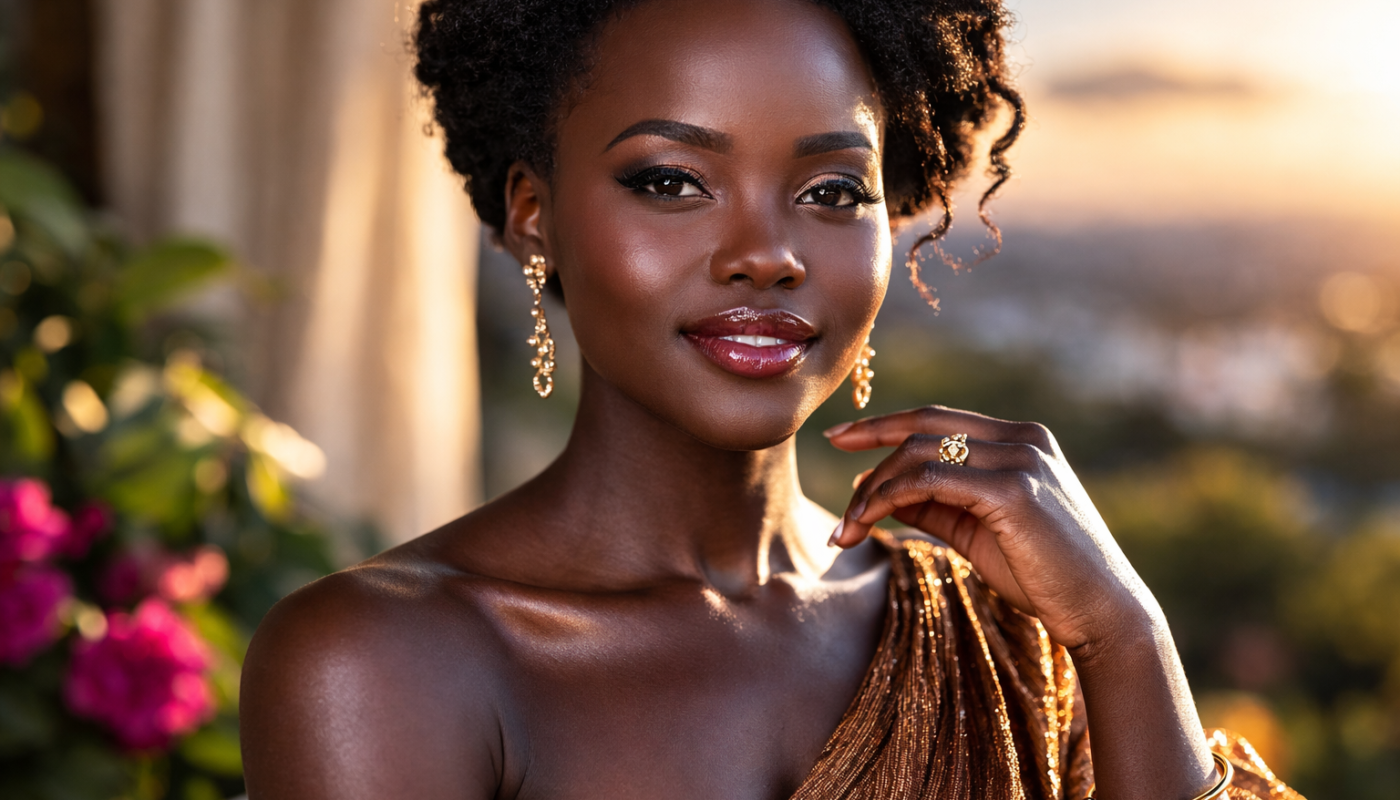
Lupita Nyong’o’s red-carpet appearances are celebrated for embracing vibrant colors, textures, and patterns that complement her natural skin tone rather than neutralize it. Her frequent choice of African-inspired fabrics and jewel tones communicates cultural pride while challenging Hollywood’s traditional beauty paradigms, which often favor lighter skin. These sartorial decisions are more than aesthetic—they’re political gestures, reinforcing the value of dark-skinned beauty in global media. Coverage in fashion publications frequently highlights how her style choices balance elegance, authenticity, and cultural symbolism, signaling that dark-skinned women can occupy both spaces of glamour and authority. This visibility creates aspirational models for audiences historically excluded from mainstream fashion narratives. Nyong’o’s wardrobe serves as a statement of empowerment, demonstrating that beauty is not merely inherited or cosmetic but can be deliberately curated to amplify identity. Each appearance becomes a cultural moment, reshaping public imagination and asserting that dark skin is not just visible but central to contemporary conceptions of elegance and sophistication. Her style choices ripple outward, influencing both audiences and industry standards while making representation tangible and aspirational.
8. The Psychological Significance of Visibility
Representation operates at a deeply psychological level, influencing self-perception, self-esteem, and social identity. For dark-skinned women, media that favors lighter tones often reinforces internalized bias, which can manifest as body dissatisfaction or diminished confidence. Lupita Nyong’o counters these dynamics by visibly occupying spaces of acclaim and influence, demonstrating that dark skin is desirable, celebrated, and powerful. Psychologists note that when individuals observe successful figures who share their appearance, they are more likely to internalize confidence and envision themselves in leadership or creative roles. Nyong’o’s prominence—from Oscar recognition to international campaigns—provides validation that resonates across generations, particularly for young audiences shaping identity and self-image. By embodying excellence while unapologetically embracing her complexion, she models aspirational selfhood, emphasizing that value and beauty are not contingent on conforming to Eurocentric standards. Her visibility extends beyond mere symbolism; it actively reshapes internalized narratives, fostering resilience and encouraging audiences to reconceptualize their own potential. In essence, Nyong’o’s presence operates as a subtle but powerful intervention in cultural and psychological landscapes.
9. Navigating Race and Gender in Global Cinema
Nyong’o’s career exemplifies the intersectional challenges faced by dark-skinned women in cinema. Historically, roles for Black women were limited and often reductive, ranging from stereotypes to secondary characters. Nyong’o strategically navigates these constraints, selecting diverse roles that balance complexity, agency, and cultural resonance. From her debut in 12 Years a Slave to leading roles in Us and Black Panther, she resists confinement to narratives of suffering or marginalization. Her choices amplify visibility for dark-skinned women while expanding the kinds of stories told about Black identity. Internationally, her success challenges filmmakers and audiences alike to reconsider entrenched portrayals, influencing cinematic norms across Africa, North America, and Europe. In this way, Nyong’o demonstrates that representation is not just about presence but about narrative richness, influencing both who is seen and how they are portrayed. Her career underscores cinema’s potential to reflect societal biases while simultaneously reshaping cultural perceptions of race, gender, and beauty.
10. Sulwe: Transforming Childhood Narratives
With her children’s book Sulwe, Nyong’o extends advocacy into literature, addressing colorism and self-esteem directly. The story follows a young girl grappling with societal bias toward lighter skin and highlights the transformative power of self-acceptance. By reframing darkness as beauty and uniqueness, Nyong’o creates a tool for cultural education and emotional empowerment. The book provides children with early exposure to diverse representations, challenging the pervasive invisibility of dark skin in literature. Educators and psychologists praise the text for fostering identity affirmation and resilience, demonstrating how celebrity influence can intersect meaningfully with educational and social development. Sulwe transforms representation from passive media exposure to active intervention, illustrating how visibility and storytelling can cultivate long-term cultural shifts. Nyong’o’s engagement in children’s literature reflects a holistic approach to advocacy, connecting personal experience with social impact and ensuring that the next generation encounters a broader spectrum of beauty ideals.
11. Challenging Global Beauty Marketing
Nyong’o’s collaborations with international beauty brands disrupt historically exclusionary marketing norms. Global campaigns have often sidelined dark-skinned models, reinforcing color hierarchies. By featuring prominently in such campaigns, Nyong’o validates darker skin tones and demonstrates that beauty transcends narrow standards. Beyond commercial success, her visibility signals social values, inspiring brands to embrace inclusivity. Marketing analysts note that her presence affects consumer perception, reshaping expectations of representation and aspirational beauty. These campaigns illustrate how celebrity influence can extend beyond cultural discourse into economic and social dimensions, ensuring that inclusivity is both visually celebrated and commercially recognized. Nyong’o thus bridges art, media, and consumer culture, embedding representation into everyday societal consciousness while asserting the desirability and significance of dark-skinned beauty on a global scale.
12. Media Amplification and Cultural Influence
Media coverage plays a critical role in amplifying Nyong’o’s cultural impact. Fashion magazines, newspapers, and online publications highlight her achievements, style, and advocacy, making her visibility accessible to global audiences. Positive framing in outlets like Vogue and Marie Claire reinforces the notion that dark-skinned women can occupy spaces of elegance, authority, and desirability. This amplified visibility not only increases public recognition but also encourages discourse about beauty standards, inclusion, and identity across different cultural contexts. The interaction between media portrayal and public reception shapes societal attitudes, creating a feedback loop where visibility fosters normalization, which then encourages broader acceptance and appreciation of diverse aesthetics. Through consistent media presence, Nyong’o exemplifies how representation extends beyond individual achievements, influencing collective imagination, social norms, and cultural expectations.
13. International Resonance and Diaspora Impact
Nyong’o’s influence is global, resonating especially with African diasporic communities. In regions where colonial legacies and Eurocentric ideals still dominate, her visibility offers a counter-narrative celebrating African identity and dark skin. By embodying elegance, intellect, and artistic excellence, Nyong’o challenges stereotypes and inspires pride across continents. Her prominence encourages filmmakers, brands, and audiences to reframe conceptions of beauty, authority, and desirability. Importantly, her resonance demonstrates that representation is not culturally isolated; images of dark-skinned women in media influence identity formation and social perception worldwide. Nyong’o bridges local and global perspectives, illustrating the transnational impact of authentic representation and the power of cinema and media to challenge deep-rooted biases.
14. Role Modeling and Mentorship
Nyong’o’s visibility functions as informal mentorship for emerging artists and audiences alike. By publicly discussing her journey with colorism, her career choices, and her advocacy work, she provides practical and symbolic guidance for young women navigating similar challenges. This mentorship extends beyond the entertainment industry, affecting self-perception, career aspirations, and cultural engagement. Her example demonstrates that success does not require conforming to dominant standards but can thrive through authenticity, strategic decision-making, and advocacy. Nyong’o’s approach offers a replicable model for how representation, intentionality, and public discourse intersect to empower marginalized communities, reinforcing both individual agency and systemic transformation.
15. The Cultural Politics of Redefining Beauty
Nyong’o’s influence highlights the cultural politics inherent in beauty representation. Beauty is rarely neutral; it reflects historical hierarchies, social power, and systemic bias. By asserting the value of dark-skinned women, Nyong’o challenges entrenched norms and prompts critical reflection on aesthetic privilege. Her visibility encourages dialogue about inclusivity, intersectionality, and social equity, illustrating that representation has political, cultural, and psychological significance. This redefinition of beauty is both symbolic and practical, shaping fashion, cinema, advertising, and literature while challenging audiences to reconsider implicit biases. Through her work, Nyong’o demonstrates that celebrating dark-skinned beauty is a transformative act that extends beyond aesthetics to cultural and social empowerment.
16. Shaping the Future of Representation
The trajectory of Nyong’o’s career suggests a promising future for inclusive representation in cinema and media. As more dark-skinned women enter high-profile roles across industries, the visibility pioneered by figures like Nyong’o creates a foundation for systemic change. Her continued advocacy, literary contributions, and media presence normalize diverse aesthetics and redefine the parameters of global beauty. Future generations may grow up with broader conceptions of desirability and worth, shaped by the cultural groundwork Nyong’o has laid. Ultimately, her influence exemplifies how visibility, intention, and strategic action intersect to transform social narratives, fostering a more inclusive, equitable, and affirming world for dark-skinned individuals.
Conclusion — The Future of Inclusive Beauty
Lupita Nyong’o’s journey from childhood internalizing biased beauty standards to becoming a global icon of dark‑skinned beauty is more than a personal triumph — it is a cultural watershed. Her articulation of the emotional toll of invisibility, her strategic navigation of the film industry, and her commitment to roles that affirm complexity over stereotype converge into a powerful legacy of inclusive representation.
Her work — in cinema, literature, and public discourse — signals how shifting media landscapes can affiliate visibility with dignity. It is a reminder that representation isn’t merely about aesthetics; it is an act of psychological empowerment, cultural affirmation, and social transformation. As global audiences continue to demand more diverse, nuanced imagery, Nyong’o’s influence offers a blueprint for how visible presence can translate into lasting change — shaping not only who we see on screens, but how we see ourselves.
Sources: Vogue, Marie Claire, Good Black News, This Is Africa, Vanity Fair, People