 by
by Beyond Representation: Why One Public Voice Helped Rewrite Beauty Narratives Across the World
Introduction: When Beauty Standards Meet History
Beauty has never been merely about appearance. Across centuries, societies have attached moral, social, economic, and political meanings to skin tone. In many parts of the world, lighter skin has often been positioned as more desirable through histories shaped by colonialism, slavery, caste systems, class divisions, media representation, and global advertising. These ideas have influenced everything from hiring practices to marriage prospects, entertainment industries, and even childhood self-esteem.
Against this backdrop, moments that genuinely shift cultural conversations are rare.
When Lupita Nyong’o emerged onto the international stage after her critically acclaimed performance in 12 Years a Slave (2013), audiences certainly noticed her remarkable acting talent. Yet another conversation unfolded alongside discussions about cinema. Millions of people around the world began talking about something Hollywood had historically struggled to embrace: the beauty of very dark skin.
Her rise did not magically erase centuries of colorism. Nor did it instantly diversify global beauty standards. But it provided something equally significant—a widely visible, globally celebrated example that challenged long-standing assumptions about who gets described as elegant, glamorous, sophisticated, or beautiful.
Unlike many celebrity narratives that rely primarily on fashion or aesthetics, Nyong’o’s influence has consistently been rooted in language, storytelling, advocacy, and thoughtful reflection. Through interviews, speeches, books, and public campaigns, she has repeatedly connected beauty with dignity, identity, history, and self-worth.
Her cultural impact extends far beyond magazine covers.
It lies in changing conversations.
How Beauty Photography Learned to See Dark Skin Differently
For decades, conversations about representation often focused on who appeared in front of the camera, while paying far less attention to how they were photographed. Beauty photography has historically been shaped by lighting techniques, camera technology, and editorial practices that frequently prioritized lighter skin tones. As a result, darker complexions were sometimes poorly lit, inaccurately exposed, or edited in ways that failed to capture their natural depth and richness. While these issues affected many people, they also reinforced the misconception that dark skin was somehow more difficult to photograph attractively. Lupita Nyong’o’s prominence challenged these assumptions in highly visible ways. Her collaborations with leading fashion photographers and luxury magazines demonstrated that darker skin possesses extraordinary dimension, warmth, and luminosity when photographed with skill and intention. Editorial spreads featuring Nyong’o often celebrated, rather than muted, the richness of her complexion through thoughtful lighting, bold colour palettes, and carefully considered styling. These visual choices influenced conversations within fashion and beauty industries about inclusive creative practices behind the camera, not just diverse casting in front of it. The broader lesson extends beyond celebrity imagery. Inclusive representation requires photographers, makeup artists, lighting technicians, and editors to understand how to showcase every skin tone respectfully and accurately. Nyong’o’s visibility encouraged greater awareness that technical excellence and cultural inclusivity are closely connected.
From Individual Confidence to Collective Cultural Confidence
One of the most enduring aspects of Lupita Nyong’o’s influence is that her message gradually expanded beyond personal self-esteem into a wider conversation about collective cultural confidence. Much public discussion around beauty encourages individuals simply to “love yourself,” but Nyong’o has consistently acknowledged that confidence does not develop in isolation. People’s perceptions of themselves are shaped by families, schools, media, advertising, and the cultural stories they inherit. By openly discussing these influences, she shifted attention from individual responsibility toward shared social accountability. This perspective has resonated across different generations, particularly among educators, parents, and young creatives seeking to build more inclusive environments. Her work encourages communities to question why certain appearances have historically been celebrated while others have been overlooked, without framing these conversations as divisive or exclusionary. Instead, they become opportunities to broaden collective understanding of beauty and human dignity. This distinction is significant because sustainable cultural change depends not only on helping individuals feel confident but also on transforming the environments that shape confidence in the first place. Through her public advocacy, storytelling, and consistent representation, Nyong’o has contributed to a cultural shift in which embracing dark-skinned beauty increasingly reflects a broader commitment to diversity, respect, and belonging rather than a temporary trend.
Understanding Colorism Before Understanding Lupita Nyong’o
To appreciate why Lupita Nyong’o’s public image resonated so deeply, it is important to distinguish racism from colorism.
Colorism refers to prejudice or preferential treatment based on skin tone, often favoring lighter skin within the same racial or ethnic community. Unlike racism, which functions across racial categories, colorism operates internally as well as externally.
Its roots differ across societies.
- Colonial administrations often privileged lighter populations.
- Slave societies rewarded proximity to whiteness.
- Certain Asian beauty traditions associated lighter skin with elite indoor lifestyles.
- Entertainment industries repeatedly cast lighter-skinned actors in leading romantic roles.
- Cosmetics industries built enormous markets around skin-lightening products.
These systems affected people differently depending on geography.
Colorism exists in:
- African countries
- South Asian societies
- Latin America
- East Asia
- Middle Eastern communities
- Caribbean nations
- African diasporas in Europe and North America
Although each context is unique, the psychological effects often overlap.
Children quickly learn which complexions receive praise.
Adults internalize assumptions about attractiveness, professionalism, intelligence, and desirability.
The result is not simply aesthetic preference—it becomes social conditioning.
Growing Up Without Seeing Yourself
One of Lupita Nyong’o’s most influential contributions has been openly discussing her childhood experiences.
In numerous verified interviews, including conversations surrounding her memoir and public speaking engagements, she has explained that she rarely saw women with skin as dark as hers celebrated in mainstream media.
This absence mattered.
Representation shapes imagination.
Children often understand what is considered “beautiful” by observing:
- advertisements
- cartoons
- films
- dolls
- television presenters
- magazine covers
- beauty pageants
If no one resembles them, they may unconsciously conclude that they exist outside accepted standards.
Nyong’o has spoken candidly about admiring lighter-skinned models because those were largely the examples available.
Importantly, she has never framed this experience as personal failure.
Instead, she has described it as a reflection of cultural messaging.
That distinction shifts responsibility away from individuals and toward larger systems.
The Oscar Moment That Became Symbolic
When Lupita Nyong’o won the Academy Award for Best Supporting Actress in 2014, history was certainly made.
Yet the significance extended beyond cinema.
Her acceptance speech emphasized possibility.
She famously expressed hope that the award would inspire young people and affirmed that dreams are valid regardless of background.
Around the same time, fashion critics consistently highlighted her elegance on red carpets.
Unlike previous eras in Hollywood, where darker skin often received minimal styling attention, designers, photographers, and luxury brands increasingly embraced her distinctive appearance.
Media narratives began changing.
Instead of asking whether dark skin could be glamorous, publications discussed how effortlessly she embodied glamour.
This shift appears subtle.
It was not.
Language influences perception.
Repeated positive framing gradually expands cultural expectations.
Fashion Without Whitening Identity
Historically, many celebrities from marginalized communities have faced subtle pressure to become more “marketable.”
This can include:
- altering hairstyles
- changing accents
- adopting Eurocentric styling
- minimizing cultural heritage
Nyong’o consistently presented herself differently.
She embraced:
- close natural hairstyles
- bold color palettes
- African-inspired fashion references
- architectural silhouettes
- natural skin tone without attempting visual lightening
Importantly, this was never marketed as rejection of others.
Instead, it communicated authenticity.
Fashion became storytelling.
Her appearance suggested that sophistication does not require conformity.
Luxury does not require proximity to whiteness.
Speaking About Beauty With Radical Honesty
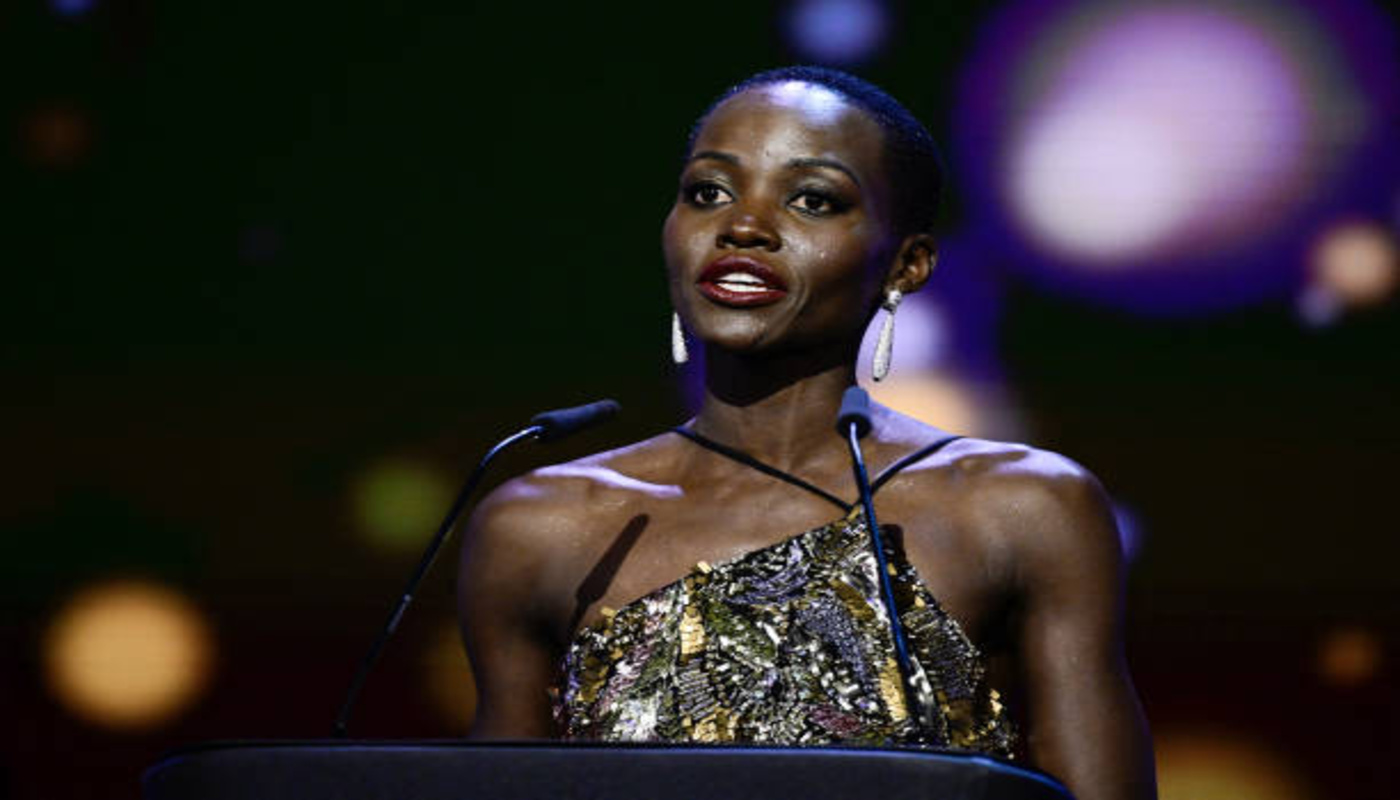
One of Lupita Nyong’o’s most widely shared public reflections came during her speech at the Essence Black Women in Hollywood event.
She recalled praying as a child to wake up lighter.
The audience response reflected collective recognition.
Many people around the world had experienced similar thoughts but rarely heard them expressed publicly.
Her speech transformed private shame into shared conversation.
Rather than presenting confidence as something she had always possessed, she acknowledged insecurity.
This honesty mattered.
Perfect confidence can feel unreachable.
Honest growth feels attainable.
Representation Is Not Vanity
Some critics dismiss conversations about beauty representation as superficial.
Psychological research suggests otherwise.
Appearance influences:
- social belonging
- educational confidence
- workplace expectations
- dating experiences
- media participation
- self-esteem
When underrepresented groups finally see themselves portrayed positively, the impact extends beyond aesthetics.
It affects identity.
Children who observe diverse beauty standards often develop broader definitions of attractiveness and belonging.
Representation does not guarantee confidence.
But absence frequently contributes to insecurity.
Why Children’s Literature Became Part of the Conversation
Nyong’o expanded these ideas through her children’s book Sulwe.
The story centers on a young girl with very dark skin who longs to look like her lighter-skinned sister.
Although fictional, the emotional experiences reflected realities shared across numerous communities.
The book avoids simplistic messaging.
Instead of merely stating, “Everyone is beautiful,” it explores:
- comparison
- family dynamics
- emotional longing
- imagination
- healing
- self-discovery
Its greatest strength lies in validating difficult emotions before offering hope.
Children rarely need lectures.
They need recognition.
The Global Reality of Skin-Lightening Industries
To understand the importance of Nyong’o’s message, one must examine the global economics surrounding skin tone.
Skin-lightening products represent multi-billion-dollar industries across various regions.
Marketing frequently promises:
- success
- confidence
- romance
- employment
- transformation
Advertisements often imply that lighter skin creates better futures.
Although regulations have tightened in many countries, messaging continues through social media, influencers, and beauty trends.
Nyong’o’s visibility offered a powerful counter-image.
Instead of selling transformation, she modeled acceptance.
Instead of changing her complexion, she challenged audiences to reconsider why change seemed necessary.
A Cross-Cultural Conversation
Her influence has reached audiences far beyond Hollywood.
Across Africa
Young creatives frequently cite her as evidence that global success does not require minimizing African identity.
Designers, photographers, and filmmakers increasingly celebrate darker skin tones in editorial work.
South Asia
Discussions around colorism have intensified in countries where fairness products historically dominated advertising.
Although progress remains uneven, public conversations increasingly question inherited beauty assumptions.
Nyong’o’s story frequently appears in these discussions because it demonstrates international recognition without altering natural complexion.
Latin America
Afro-Latin communities have similarly engaged with her work while discussing representation in regional media.
Her visibility contributes to broader conversations about Afro-descendant identity.
Europe and North America
Among Black diaspora communities, Nyong’o represents one example within a growing movement advocating wider representation across entertainment and fashion.
Beauty as Language
One overlooked aspect of Lupita Nyong’o’s influence is vocabulary.
Before broader representation, descriptors for darker skin often focused on neutrality rather than admiration.
Her public presence helped popularize richer language.
Writers increasingly described darker skin using words like:
- radiant
- luminous
- rich
- glowing
- regal
- striking
- elegant
Language shapes imagination.
Repeated positive descriptors gradually reshape cultural expectations.
Challenging the “Exception” Narrative
Whenever marginalized individuals achieve extraordinary success, societies sometimes frame them as exceptions.
This creates another problem.
If one successful person becomes “proof” that inequality has disappeared, structural issues remain invisible.
Nyong’o herself has consistently emphasized broader representation rather than individual celebration.
Her career does not suggest that discrimination has ended.
Instead, it highlights what becomes possible when opportunities expand.
The Psychology of Visibility
Researchers studying identity formation often emphasize mirrors.
Not literal mirrors.
Social mirrors.
People understand themselves partly through reflected cultural messages.
When those reflections improve, internal narratives can change.
Visibility influences:
- confidence
- aspirations
- belonging
- resilience
- identity development
Nyong’o became one such mirror for countless individuals who had rarely seen themselves celebrated publicly.
Social Media Amplified the Message
Unlike earlier generations of celebrities, Nyong’o’s rise occurred alongside global social media.
Images from red carpets circulated instantly.
Young people reposted interviews discussing self-worth.
Teachers shared excerpts from speeches.
Parents introduced Sulwe to children.
Hashtags celebrating dark skin became more common.
Although online spaces still perpetuate colorism, they also enabled communities resisting it to organize around shared affirmation.
Beauty Without Perfection
Another reason Nyong’o resonates culturally is her refusal to present beauty as effortless perfection.
Her interviews consistently emphasize growth, learning, gratitude, and identity rather than flawless confidence.
This creates healthier narratives.
Confidence becomes a practice.
Not a permanent personality trait.
Why Brands Began Paying Attention
Luxury fashion and beauty companies increasingly recognized consumer demand for broader representation.
Nyong’o became associated with campaigns demonstrating that prestige marketing could successfully feature darker skin without treating diversity as novelty.
However, genuine inclusion requires more than individual ambassadors.
It also demands:
- inclusive shade ranges
- diverse photographers
- varied creative teams
- equitable casting
- long-term commitments
Representation should become standard practice rather than seasonal campaigns.
Critiques Worth Considering
Balanced analysis also requires acknowledging limitations.
No single celebrity can dismantle centuries of colorism.
Visibility alone cannot solve:
- employment discrimination
- educational inequality
- dating biases
- media monopolies
- colonial beauty legacies
Additionally, commercial industries sometimes celebrate diversity while continuing unequal practices behind the scenes.
These critiques do not diminish Nyong’o’s influence.
Rather, they place it within realistic expectations.
Cultural change occurs collectively.
Public figures can accelerate conversations, but institutions must also evolve.
Lessons for Parents, Educators, and Media Creators
Lupita Nyong’o’s cultural impact offers practical insights beyond celebrity culture.
Parents can diversify children’s books, dolls, and media.
Teachers can discuss colorism alongside broader histories of identity.
Photographers can light darker skin thoughtfully rather than treating it as technically difficult.
Fashion editors can normalize diversity without presenting it as extraordinary.
Filmmakers can expand casting decisions beyond familiar beauty archetypes.
Each decision shapes future generations.
Moving Beyond Representation Toward Belonging
Representation answers an important question:
Can someone like me be seen?
Belonging asks something deeper:
Can someone like me simply exist without explanation?
Nyong’o’s career increasingly points toward this second stage.
Rather than continually discussing whether darker skin deserves admiration, future conversations may simply assume it.
That shift—from justification to normalization—is where lasting cultural change occurs.
Conclusion: A Conversation Still Being Written
Lupita Nyong’o did not invent confidence for dark-skinned women. Nor was she the first person to celebrate darker complexions. Artists, activists, scholars, writers, photographers, and communities across Africa and the global diaspora had long challenged narrow beauty standards before her international breakthrough.
What she accomplished was different.
She carried those conversations into some of the world’s most influential cultural spaces—Hollywood, luxury fashion, global publishing, children’s literature, and international media—and did so with remarkable consistency and thoughtfulness. Rather than relying solely on visibility, she used interviews, speeches, and storytelling to invite audiences to question why certain beauty ideals became dominant in the first place.
Her influence also reminds us that representation is not about replacing one ideal with another. The goal is not to crown a new “perfect” standard, but to expand the definition of beauty until no child feels invisible because of their complexion. In that sense, her legacy is less about celebrity and more about possibility.
The future of body inclusivity and beauty inclusivity depends on continuing this work. It requires industries that invest in authentic diversity rather than symbolic gestures, educators who acknowledge the emotional impact of colorism, families who encourage children to appreciate the richness of all skin tones, and media creators who portray beauty as multifaceted rather than hierarchical.
Years from now, the most meaningful measure of Lupita Nyong’o’s impact may not be the awards she earned or the magazine covers she graced. It may be the countless people who grow up never questioning whether their skin deserves admiration because they inherited a world where that conversation has already begun to change.
Sources: Academy of Motion Picture Arts and Sciences, Essence, British Vogue, The New York Times, Time, CNN, BBC, Harper’s Bazaar, Elle, The Guardian, The Hollywood Reporter, Penguin Random House, UNICEF, Vanity Fair, Allure