 by
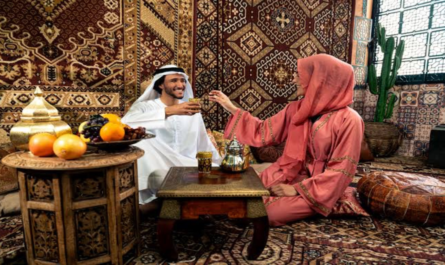
by A beautifully embroidered abaya photographed against a glass skyscraper. A traditional Saudi motif reworked into a contemporary jacket. A Ramadan gathering filmed with the same cinematic polish as a global fashion campaign. A centuries-old beauty ritual explained through a short-form video.
These images can appear contradictory at first: the old beside the new, inherited customs alongside global trends, cultural memory presented through algorithms designed to reward novelty. Yet for many Middle Eastern influencers and creators, the contradiction is precisely the point.
Tradition and modernity are not necessarily opposing forces. Increasingly, they function as two languages through which identity is communicated.
This is particularly significant for body inclusivity. Discussions about representation often focus on whether people see themselves reflected in media, but representation is also about how bodies are allowed to exist within culture. Clothing, modesty, beauty rituals, age, femininity, masculinity, regional identity and physical presentation all influence whether someone feels culturally visible. Middle Eastern creators are contributing to this conversation by demonstrating that cultural belonging does not require abandoning contemporary self-expression.
Their influence extends beyond fashion. They are helping audiences negotiate a psychological question that is particularly relevant in a globalized digital environment: Can I participate in modern culture without becoming disconnected from where I come from?
The answer increasingly appears to be yes.
Tradition Is Not a Museum Piece
One of the most persistent misunderstandings about tradition is that it must remain unchanged to remain authentic.
Cultures, however, have never been static. Clothing changes. Languages evolve. Beauty practices are reinterpreted. Family rituals adapt to new technologies. Food travels across borders. Even the meaning attached to familiar objects can shift between generations.
Middle Eastern influencers operate inside this living process.
Consider the transformation of heritage-inspired clothing. Saudi fashion in particular has increasingly demonstrated how traditional references can be incorporated into contemporary silhouettes, fabrics and styling. Arab News has documented designers drawing on regional embroidery, architectural patterns, palm trees, Bedouin imagery, Saudi coffee culture and traditional garments while creating pieces designed for contemporary audiences. (Arab News)
That distinction matters.
The goal is not necessarily to recreate what a grandmother wore exactly as she wore it. It may instead be to ask what an inherited visual language can become when interpreted by someone living in 2026.
Saudi designer Lama Al-Bluwi provides an illuminating example. Her work drew on her family’s Bedouin heritage in AlUla while translating those references into modern garments such as coats, jackets and oversized T-shirts. She described her intention as presenting heritage in a more fashionable and contemporary way. (Arab News)
The cultural significance is larger than clothing.
It suggests that younger generations do not necessarily have to choose between ancestral identity and contemporary identity. They can reinterpret one through the other.
That is an important psychological shift.
The Digital Generation Is Building a “Both/And” Identity
Much of modern internet culture encourages binary thinking.
Traditional or progressive.
Local or global.
Modest or fashionable.
Natural or glamorous.
Eastern or Western.
But lived identities are rarely so tidy.
A young woman in Riyadh can appreciate international fashion while wearing an abaya. A creator in Dubai can discuss global beauty techniques while drawing inspiration from Arab cosmetics traditions. An Iranian fashion personality can embrace contemporary Parisian styling while retaining cultural references from home.
Social media makes these combinations visible.
Research into Muslim fashion influencers has found that social media can function as a space where modesty is actively redefined rather than simply inherited. One qualitative study examining Muslim fashion influencers found that creators were using Instagram to negotiate what modest apparel could look like, including through their styling choices and commercial collaborations. (CUNY Academic Works)
More recent scholarship goes further. A 2026 study of Muslimah influencers found that creators can face criticism from followers, other participants in modest-fashion communities and sometimes family members over interpretations of Islamic modesty. The researchers describe influencers responding through critical Islamic reasoning and positioning their aesthetic work as part of a broader negotiation of faith and identity. (Wiley Online Library)
This reveals something important about influencer culture.
The creator is not simply transmitting a finished cultural rule to an audience.
They are often negotiating it publicly.
That negotiation can be uncomfortable, but it can also be culturally productive.
Why Modesty Can Become a Form of Contemporary Self-Expression
Western fashion discourse has sometimes treated modesty as the opposite of self-expression.
That assumption is increasingly difficult to sustain.
Modest fashion can involve color, tailoring, texture, layering, jewelry, movement, silhouette and personal styling. The question is not whether a person is expressing themselves, but which visual vocabulary they are using.
Across the Middle East, the abaya, kaftan, jalabiya, thobe, bisht and other traditional or culturally associated garments can become starting points for experimentation.
Saudi Ramadan fashion offers a particularly revealing case. Designers have used Ramadan collections to combine contemporary fashion with Arab cultural references, while social occasions such as iftar, family gatherings and Eid create spaces in which clothing carries both social and cultural meaning. (Arab News)
This is relevant to body inclusivity because clothing can change the relationship between the body and public visibility.
Instead of requiring the body to conform to one universal fashion silhouette, modest fashion can create multiple ways of presenting oneself.
A flowing garment can emphasize movement rather than measurement.
Layering can prioritize comfort and personal aesthetics.
An oversized silhouette can become fashionable rather than something that needs to be “corrected.”
Long-established cultural garments can therefore participate in contemporary conversations about choice and bodily autonomy.
This does not mean modest fashion is automatically liberating, nor that traditional dress is automatically restrictive. Either conclusion would flatten an extraordinarily diverse region.
Its significance lies precisely in the fact that women and men can attach different meanings to the same garment.
The Middle East Is Not One Aesthetic
The phrase “Middle Eastern influencer” can itself be misleading.
The Middle East contains enormous linguistic, religious, ethnic, geographic and historical diversity. Saudi Arabia is not Lebanon. Iran is not the United Arab Emirates. Jordan is not Egypt. Gulf culture cannot simply be treated as interchangeable with Levantine culture, and urban identities can differ substantially from rural ones.
Even within individual countries, regional identities matter.
Saudi designers, for example, have drawn from the Asir region, AlUla, Qassim, Al-Ahsa, the Hijaz and other parts of the country rather than treating “Saudi heritage” as a single visual category. A 2026 Arab News report on contemporary Saudi fashion highlighted collections representing different regions through motifs, symbolism and patterns. (Arab News)
That regional specificity is valuable for inclusivity.
Representation becomes more meaningful when it moves beyond a generic “Arab look.”
A person does not need to resemble an internationally recognizable stereotype to be culturally authentic.
This is particularly important for younger audiences growing up online, where algorithms can compress complex cultures into simplified visual trends.
The creator who explains why a particular embroidery pattern matters, or where a particular garment originates, is doing more than producing aesthetic content. They are adding context to the image.
From Cultural Preservation to Cultural Reinvention
There is a fascinating difference between preserving tradition and preserving the ability to reinterpret tradition.
The first approach can sometimes treat culture as something fragile that must be protected from change.
The second recognizes that cultures survive partly because people continue finding new reasons to care about them.
This is visible in Saudi creative industries.
Tala Abukhaled, founder of the Saudi label Rebirth, has explicitly connected contemporary design with Saudi artistic heritage. Her collections have incorporated elements such as palm materials, bisht embroidery and the shemagh into modern garments. One collection transformed bisht embroidery into pieces including a bomber jacket and palazzo pants. (Arab News)
Likewise, Saudi label HINDAMME’s collaboration with Arts AlUla’s Madrasat Addeera has brought ancient AlUla heritage into contemporary design. (Arab News)
These examples reveal a broader cultural movement: heritage can become a design resource rather than merely an archive.
Influencers amplify this process because social media turns cultural reinterpretation into something audiences can immediately see, discuss, imitate and share.
A teenager may encounter an ancestral motif not inside a museum but through a creator’s outfit video.
That changes the emotional relationship with heritage.
Instead of thinking, “This belongs to the past,” the viewer may begin thinking, “This belongs to me.”
Beauty Is Another Site of Cultural Negotiation
The blending of tradition and modernity is perhaps even more visible in beauty culture.
Huda Kattan is a particularly well-documented example of Middle Eastern beauty aesthetics moving across cultural borders. In interviews, Kattan has spoken about growing up in the United States without seeing much representation of people like herself and about how her Arab heritage influenced her approach to beauty. She has also discussed how social media allowed Middle Eastern and Western beauty trends to influence one another. (Allure)
Her story illustrates a significant reversal in the traditional flow of beauty influence.
For decades, global beauty media often positioned Western standards as the default and exported them outward.
Digital platforms disrupted that hierarchy.
Kattan’s own account of beauty culture emphasized techniques and ingredients associated with Arab and South Asian communities, while her dramatic eye-makeup aesthetic found audiences far beyond the region. Vogue India described her as helping take a Middle Eastern beauty aesthetic into Western markets and highlighted her use of culturally familiar ingredients and techniques. (Vogue)
This is culturally meaningful because beauty representation affects more than purchasing behavior.
It affects recognition.
When a person sees features, makeup styles, hair practices or beauty rituals associated with their own cultural background represented as desirable rather than exotic or outdated, the psychological message can be powerful:
You do not have to erase the visual language you inherited to participate in contemporary beauty culture.
Body Inclusivity Is Bigger Than Size
Body inclusivity is often reduced to conversations about weight.
That is far too narrow.
Bodies are also culturally interpreted through age, skin tone, hair, facial features, clothing, disability, gender expression, religious presentation and ideas about femininity and masculinity.
Middle Eastern creator culture offers several useful examples of why representation should be understood more broadly.
Iran Khanoom, an Iranian fashion personality who became an influencer in her nineties, represents an especially compelling case. Harper’s Bazaar Arabia documented how her Instagram presence developed into a multigenerational family project involving fashion, humor, cultural commentary and discussions around women’s rights and social justice. (Harper’s Bazaar Arabia)
Her importance is not simply that she is older.
It is that social media gave age visibility a different context.
Traditional fashion imagery has often associated glamour, trendiness and desirability with youth. An older woman participating visibly in fashion disrupts that assumption without needing to pretend she is younger.
She does not have to become “young enough” to belong.
She belongs as herself.
That is a powerful body-inclusivity message.
It expands the visual imagination of who gets to be stylish, expressive and culturally relevant.
The Emotional Power of Seeing “Someone Like Me”
Representation is sometimes discussed as though it is purely statistical.
How many women?
How many people of color?
How many people from a particular region?
But representation also has an emotional dimension.
Huda Kattan has directly described the experience of growing up without seeing people of Middle Eastern heritage represented in beauty media and how that affected her sense of inclusion. (Glamour UK)
That experience is familiar across many communities.
When mainstream imagery repeatedly suggests that beauty belongs to someone else, individuals can internalize the idea that they must modify themselves before they qualify.
Influencers can interrupt that process by presenting cultural features and practices as ordinary parts of modern life.
Not as a novelty.
Not as an exotic exception.
Not as something that needs explanation before it can be appreciated.
This distinction matters enormously for young audiences.
A teenager who sees someone with a similar cultural background confidently navigating fashion, business, beauty or public life receives a different psychological message from one who sees their culture represented only as historical imagery.
The first communicates possibility.
Social Media Has Turned Cultural Negotiation Into a Public Conversation
Previous generations often negotiated cultural change privately.
Parents and children debated clothing at home.
Grandparents explained traditions during family gatherings.
Young people experimented with new styles among friends.
Social media moves some of these conversations into public view.
A creator can post a contemporary interpretation of traditional clothing and receive thousands of comments from people debating whether the look feels authentic, respectful, fashionable or appropriate.
That can create tension.
But tension does not necessarily indicate cultural failure.
Sometimes it demonstrates that culture is being actively discussed.
Research on Muslim influencer culture shows precisely this kind of negotiation, including disagreements around modesty and religious presentation. (Wiley Online Library)
The challenge is that digital disagreement can become judgmental very quickly.
Influencers can be criticized for being “too traditional” or “not traditional enough.”
A woman may be criticized for how she dresses from completely different ideological directions.
This is where body inclusivity becomes particularly relevant.
An inclusive cultural environment should not simply replace one rigid beauty standard with another.
It should make room for complexity.
The Risk of Creating a New “Perfect Middle Eastern Woman”
There is an important contradiction within influencer culture.
Creators can challenge Western beauty standards while simultaneously creating new forms of perfection.
A highly curated image may include cultural authenticity, luxury fashion, flawless makeup, beautiful architecture, idealized family gatherings and an apparently effortless lifestyle.
The result can become another impossible composite.
The message may unconsciously shift from:
“You can be yourself.”
to:
“You can be yourself—but your self should look perfectly styled.”
This is why cultural representation and body inclusivity must not be treated as automatically synonymous.
Seeing more Middle Eastern women online does not automatically mean seeing more diverse Middle Eastern bodies.
A campaign can celebrate heritage while still presenting a narrow beauty ideal.
An influencer can make modest fashion more visible while still participating in highly polished visual culture.
A traditional garment can be modernized without making fashion itself more accessible.
Nuance matters.
The goal should not be to criticize creators for participating in beauty culture. Fashion, makeup and aesthetics can be joyful, creative and empowering.
The more useful question is whether audiences are being offered multiple ways of belonging.
Authenticity Is Becoming More Complicated
The word “authenticity” has become one of social media’s most heavily used concepts.
Yet authenticity online is always mediated.
Lighting is selected.
Clothes are chosen.
Captions are edited.
Camera angles are considered.
Brands may be involved.
Even a deliberately casual video is still a piece of content.
Middle Eastern creators therefore operate within a fascinating paradox: they are often expected to represent “real culture” while simultaneously creating content that works within global platform aesthetics.
This can produce pressure.
If a creator looks too Westernized, audiences may question cultural authenticity.
If the creator emphasizes tradition too strongly, international audiences may perceive the content through stereotypes.
The most interesting creators often refuse both extremes.
They demonstrate that authenticity does not mean reproducing the past unchanged.
It can mean being honest about living in the present while carrying the past with you.
Ramadan Shows How Tradition and Digital Modernity Can Coexist
Ramadan provides one of the clearest examples of this intersection.
The month remains deeply connected to faith, family, food, generosity and community, yet it is also a major digital season.
Google’s research has documented significant changes in online behavior during Ramadan, including increased video consumption and heightened interest in cooking, beauty, fashion, gifting, travel and religious content. (Google)
That combination creates an unusual cultural environment.
A creator can post a recipe inherited from family tradition using contemporary video editing.
They can share an Eid outfit inspired by heritage but styled for today’s audience.
They can discuss beauty preparations alongside reflections about family and community.
They can move between the intimate and the commercial within the same digital ecosystem.
This does not necessarily dilute tradition.
Sometimes technology becomes the mechanism through which tradition travels.
The important distinction is whether the tradition is merely being used as an aesthetic prop or whether the creator gives it context and meaning.
From Local Inspiration to Global Cultural Exchange
The cultural flow is no longer one-directional.
Middle Eastern creators increasingly participate in global fashion and beauty conversations while international audiences borrow, remix and reinterpret regional aesthetics.
This is visible in beauty.
Kattan has described the convergence of Middle Eastern and Western beauty trends, emphasizing that influence now moves in both directions. (Allure)
It is also visible in fashion.
Saudi designers have increasingly positioned local heritage as something capable of entering international markets rather than something that must be simplified for global consumption. Designers interviewed by Arab News have explicitly discussed using fashion as a way to represent Saudi culture internationally. (Arab News)
This matters because globalization does not have to mean cultural homogenization.
The internet can produce sameness, but it can also produce cultural specificity.
A person in London can discover an Emirati designer.
A viewer in New York can learn about Saudi embroidery.
A South Asian audience can embrace Middle Eastern beauty techniques.
A Middle Eastern diaspora teenager can reconnect with heritage through fashion.
Influence becomes circular rather than hierarchical.
The Diaspora Adds Another Layer
For Middle Eastern creators living outside the region, tradition and modernity can become intertwined with questions of belonging.
Diaspora identity often involves moving between cultural environments.
Someone may speak one language at home and another at school.
They may celebrate religious or cultural holidays while consuming global entertainment.
They may dress differently depending on context.
Social media allows these different parts of identity to appear together.
This can be psychologically affirming.
Instead of choosing one identity for one environment and another identity elsewhere, creators can construct a digital space where both coexist.
That is particularly important for people who grew up feeling culturally “in between.”
The influencer becomes not merely a trendsetter but a translator between worlds.
What This Means for Body Inclusivity
The connection between cultural identity and body inclusivity deserves much greater attention.
A truly inclusive media environment should not ask people to separate their bodies from their cultures.
For Middle Eastern audiences, appearance can carry cultural meaning.
Hair can be associated with family traditions.
Clothing can communicate regional identity.
Makeup can connect generations.
Jewelry can carry historical symbolism.
Modesty can intersect with faith, personal preference and social expectations.
Age can influence how femininity is publicly understood.
When creators bring these dimensions into contemporary media, they broaden the definition of what a culturally visible body can look like.
That does not require every creator to be radically different from conventional beauty standards.
Inclusion does not mean eliminating beauty.
It means refusing to make one version of beauty the price of cultural visibility.
The New Cultural Confidence
Perhaps the most important shift is psychological.
For decades, modernization was sometimes presented through the language of replacement:
Old versus new.
Traditional versus contemporary.
Local versus international.
But a younger generation is increasingly demonstrating another model:
inherit, reinterpret, participate.
That model allows someone to admire international fashion while loving traditional clothing.
It allows a beauty creator to use global cosmetics while celebrating regional beauty techniques.
It allows an older woman to become a fashion influencer without apologizing for her age.
It allows heritage to appear in contemporary design without being reduced to costume.
And it allows a person to participate in global culture without treating their cultural background as baggage.
Influence Is Becoming Less About Dictating and More About Demonstrating
The traditional celebrity model depended heavily on distance.
The star appeared on television or in magazines.
The audience watched.
Influencer culture changed the relationship.
Creators demonstrate how they live, dress, create, cook, work and interpret culture.
That creates a different form of social influence.
YouTube’s own research describes creators as capable of building deeply engaged communities through personal connection and trust. (Google)
For Middle Eastern creators, that trust can make cultural experimentation feel less intimidating.
A viewer may not think, “I am modernizing my culture.”
They may simply think:
“I like that outfit.”
“I want to try that makeup.”
“I never knew that pattern came from my region.”
“I can wear this too.”
That ordinary feeling can be culturally transformative.
Change often becomes sustainable when it stops feeling like a political project and starts feeling like everyday life.
The Future: Heritage Without the Pressure of Perfection
The next stage of Middle Eastern digital culture may therefore be less about proving that tradition and modernity can coexist and more about making that coexistence ordinary.
The strongest cultural storytelling will likely move beyond predictable images of heritage.
It can include different ages.
Different body shapes.
Different regional identities.
Different economic realities.
Different levels of religious observance.
Different fashion preferences.
Different relationships with tradition.
That diversity is crucial.
Otherwise, “modern Middle Eastern identity” could become another polished aesthetic with its own narrow rules.
The more valuable future is one in which heritage provides a foundation rather than a uniform.
A person should be able to wear a traditional garment because they love it, reinterpret it because they enjoy experimenting, or choose something entirely contemporary without having their cultural belonging questioned.
Likewise, body inclusivity should not demand that everyone celebrate their appearance in the same way.
Some people love glamour.
Some prefer simplicity.
Some wear makeup.
Some do not.
Some embrace modest fashion.
Others prefer contemporary silhouettes.
Some enjoy traditional clothing only during cultural occasions.
All of these experiences can exist within the same cultural landscape.
Conclusion: The Future Is Not Either Tradition or Modernity
The most compelling Middle Eastern influencers are not necessarily choosing between the past and the future.
They are demonstrating that the two can speak to one another.
A heritage motif can appear on a modern garment.
A family beauty ritual can become a viral tutorial.
A traditional Ramadan gathering can become digital storytelling.
An older woman can become a fashion personality.
A regional aesthetic can travel internationally without losing its origins.
And a person can participate in global culture without needing to erase the cultural details that make their identity recognizable to themselves.
For BodyInclusivity, this matters because inclusion is ultimately about more than being visible. It is about being visible without having to become someone else first.
Middle Eastern influencer culture offers an important lesson in that regard. Modernization does not have to mean cultural disappearance. Globalization does not have to mean visual sameness. Tradition does not have to mean stagnation.
The future may instead belong to a more flexible idea of identity—one where people inherit, adapt, question, celebrate and reinvent.
That is not the disappearance of tradition.
It may be one of the ways tradition survives.
And perhaps the most powerful image of cultural modernity is not a person choosing between two worlds, but someone standing comfortably in both.
Sources: Vogue Arabia, Arab News, Harper’s Bazaar Arabia, Allure, Vogue India, Glamour, TIME, Think with Google, Journal for the Scientific Study of Religion, CUNY Academic Works
Keywords: Middle Eastern influencers, tradition and modernity, Middle Eastern fashion, body inclusivity