 by
by For generations, a woman could spend an entire summer worrying about a few millimetres of hair.
An underarm accidentally visible in a sleeveless photograph. A leg that had not been shaved before an unexpected invitation to the beach. A faint moustache noticed beneath makeup. A bikini line that did not conform to the polished, hairless image presented in advertisements.
Body hair itself was never the unusual part. It was the expectation that it should be absent.
That expectation is now being challenged in an unexpected place: the internet.
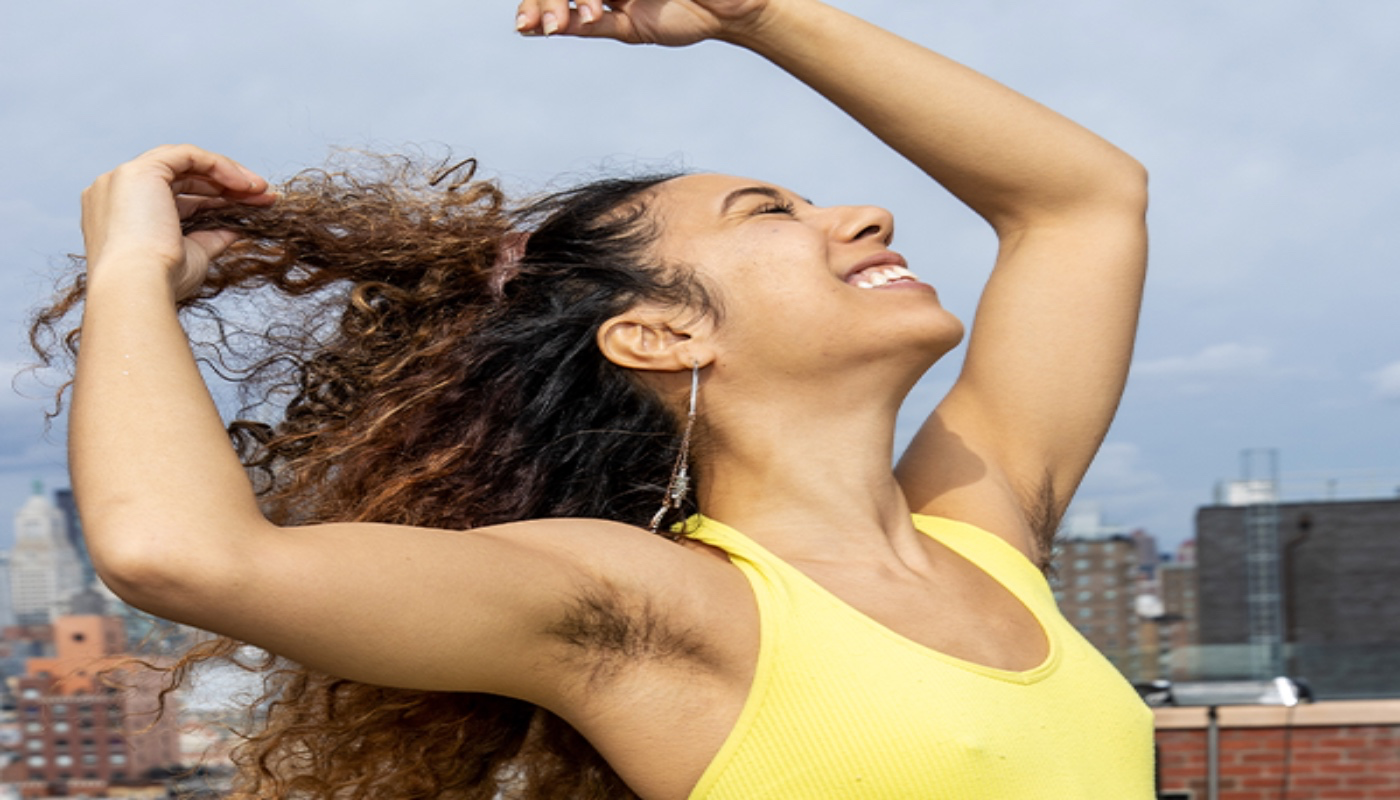
Across Instagram, TikTok, YouTube, Pinterest and other digital spaces, images of unshaven legs, visible underarm hair, facial hair, moustaches, arm hair and natural pubic hair have increasingly become part of conversations about beauty and identity. Some people post their hair deliberately as an act of self-acceptance. Others simply stop hiding it. Some continue removing it but reject the idea that grooming should be mandatory. And many are less interested in declaring a permanent position than in reclaiming the right to decide what happens to their own bodies.
This distinction matters.
The rise of body-hair acceptance online is not necessarily the replacement of one beauty rule with another. It is potentially something more significant: a challenge to the assumption that there should be a single correct way for a body to appear.
Research published in Sexuality & Culture in 2026 describes women’s hairlessness as a deeply normalized beauty standard, noting that women are often expected to remain hairless from the neck down even though body hair is generally treated as natural for men. The review connects the expectation to gendered social hierarchies and examines the psychological and social forces that sustain it. (OpenURL EBSCO)
Online culture has given that old expectation a new environment in which to be questioned.
And the change is not simply about hair.
It is about who gets to define what looks feminine, clean, attractive, respectable or socially acceptable.
When Hair Became Something Women Were Expected to Hide
Human body hair is ordinary biology. The cultural meaning attached to it is not.
Hair can communicate age, gender, identity, ethnicity, religious practice, fashion and personal preference. But these meanings are not fixed. Anthropological research has long treated the body as something shaped by social and historical expectations rather than merely as a biological object. Beauty practices can therefore become ways in which societies communicate ideas about femininity, masculinity and belonging. (Annual Reviews)
In the United States, the modern association between feminine beauty and widespread hair removal developed particularly strongly during the early twentieth century.
The Smithsonian’s National Museum of American History documents how razor manufacturers seeking new consumers began marketing specifically to women. Gillette introduced the Milady Décolleté razor in 1915. As sleeveless clothing and shorter dresses made women’s underarms and legs more visible during the 1920s, advertisers increasingly presented smooth skin as a desirable feminine standard. Importantly, advertisers often avoided framing the practice as “shaving” because shaving was culturally associated with men’s facial hair. Instead, women were encouraged to pursue “smoothness.” (Smithsonian Institution)
The commercial story is revealing because it demonstrates how quickly an ordinary physical characteristic can become reinterpreted as a problem.
Hair did not suddenly become biologically undesirable.
Its visibility changed.
Fashion exposed more skin. Advertising identified a new aesthetic concern. Products were created to address it. Repeated messages helped transform a commercial opportunity into a social expectation.
By the time the practice became routine, its commercial origins could become almost invisible.
A woman might think she was shaving because she personally preferred smooth legs, while simultaneously feeling uncomfortable about the possibility of being seen with hair. The two experiences can coexist.
That is one of the most important complexities in the body-hair conversation.
Personal grooming can be pleasurable, practical or expressive while also being influenced by social pressure.
The Difference Between Choice and Obligation
Body-hair acceptance is sometimes misunderstood as an argument that everyone should stop shaving.
That is not what the most meaningful version of the movement is about.
The deeper argument is that shaving, waxing, threading, trimming, bleaching, laser removal or leaving hair untouched should not determine whether someone is considered feminine, hygienic, attractive or respectable.
This distinction changes the conversation from hair versus no hair to choice versus compulsory conformity.
Someone can love the feeling of freshly shaved legs and still support body-hair acceptance.
Someone can dislike underarm hair on themselves and still believe another person should not be mocked for keeping theirs.
Someone can remove facial hair for aesthetic reasons while rejecting the idea that facial hair makes another woman less feminine.
The cultural significance lies in separating preference from obligation.
This is especially important because research has found that social norms play a major role in hair-removal practices. A classic study published in Psychology of Women Quarterly found that many American women reported removing leg and/or underarm hair, with both attractiveness-related and social-normative reasons influencing the practice. (Sage Journals)
More recent scholarship continues to describe feminine hairlessness as highly normalized.
That normalization can make a social rule feel like an individual preference.
The internet has begun making the rule visible.
Instagram Turned the Hidden Into Something Visible
Before social media, a person encountering an unshaven woman might have considered the sight unusual simply because they rarely saw it represented publicly.
Digital platforms changed the mathematics of visibility.
One person posting an unshaven leg creates one image.
Thousands of people doing it create a visual category.
That distinction is enormous.
Movements such as #Januhairy demonstrated how social media could transform a personal grooming decision into a collective cultural conversation. The 2019 campaign encouraged women to grow out their body hair during January and share photographs online, making visible something that conventional beauty imagery frequently concealed. (Allure)
The significance was not that January suddenly became a month when women discovered body hair.
They already had it.
The significance was that they began seeing other people publicly refusing to hide it.
This is one of social media’s unusual powers: normalization through repetition.
A single unconventional image can be dismissed as eccentric.
A thousand similar images begin to challenge the definition of what is conventional.
The Psychological Power of Seeing Yourself Represented
Representation does not automatically transform body image, but visibility can affect the range of appearances people perceive as socially possible.
That matters because appearance ideals work partly through comparison.
If someone’s social environment repeatedly presents one version of femininity—hairless, carefully groomed, edited and polished—that version can begin to feel like the baseline.
The opposite can also happen online.
Repeated exposure to ordinary bodies with visible hair can weaken the assumption that hairlessness is the universal default.
Research on social media and body image increasingly supports the importance of the type of content people encounter. A 2025 study in Body Image examining 454 women found that engagement with appearance-ideal content was associated with more negative body-image outcomes through mechanisms including thin-ideal internalization, while engagement with body-positive content was associated with aspects of more positive body image. The researchers also emphasized that the effects of different forms of content are not identical. (DOI)
This nuance is important.
Social media is not inherently liberating.
It depends on what it repeatedly teaches the viewer to notice.
A feed filled with flawless grooming can reinforce constant self-surveillance.
A feed containing diverse bodies can broaden visual expectations.
But even body-positive content can become another form of performance if users begin feeling that they must publicly demonstrate confidence, naturalness or empowerment.
The goal, therefore, should not be another compulsory aesthetic.
It should be greater freedom from compulsory aesthetics.
From “Ew” to “It’s Just Hair”
Perhaps one of the most revealing aspects of the online body-hair conversation is the emotional intensity that visible hair can provoke.
Words such as “gross,” “unclean,” “masculine” or “unfeminine” have historically been attached to women’s body hair in popular culture.
These reactions reveal that hair is not being judged merely as hair.
It is being interpreted symbolically.
The academic literature on feminine hairlessness has repeatedly identified hair as a boundary marker between masculine and feminine bodies. A 2003 study in Women’s Studies International Forum argued that the hairlessness norm helps construct an appropriately feminine body by presenting the unaltered female body as somehow insufficiently feminine. (ScienceDirect)
That helps explain why a small amount of visible hair can generate a surprisingly strong social reaction.
The reaction is cultural rather than proportional to the physical phenomenon itself.
A few strands are not objectively dramatic.
The meaning attached to them can be.
Online acceptance movements challenge that meaning by repeating a much simpler message:
It is hair.
It grows.
People can remove it.
People can keep it.
Neither decision needs to become a moral statement.
The Power—and Contradiction—of Beauty Brands
One of the most fascinating developments in the body-hair conversation is that commercial beauty companies have sometimes helped challenge the standards their industries historically benefited from.
Billie’s Project Body Hair is one of the clearest examples.
The razor company launched a campaign in 2018 explicitly showing women’s body hair, challenging the long-established convention of razor advertisements depicting women shaving already hairless skin. Billie itself describes the campaign as an effort to address the absence of female body hair in mainstream visual imagery. (MyBillie)
The campaign became culturally significant precisely because of its contradiction.
A razor company was showing women who did not necessarily need its razor.
Billie’s later “Red, White and You Do You” campaign went further by showing women with different levels of underarm and pubic hair and emphasizing personal choice. Contemporary coverage described the campaign as an attempt to normalize female body hair while allowing women to decide how much grooming they wanted. (Marketing Dive)
This creates an important question:
Can a movement toward body acceptance be genuinely meaningful when it is also being marketed?
The answer is complicated.
Commercialization can make previously marginalized imagery more visible. Advertising can expose millions of people to representations they rarely encounter elsewhere.
At the same time, companies have economic incentives to turn cultural dissatisfaction into products, campaigns and brand identities.
That does not automatically invalidate the representation.
It simply means audiences should distinguish visibility from liberation.
A brand can normalize body hair while still selling razors.
A person can appreciate the representation while continuing to shave.
A campaign can influence culture without eliminating the commercial system surrounding grooming.
These contradictions are not failures of the movement. They are part of its complexity.
When “Natural” Becomes Another Beauty Standard
There is another danger in the rise of body-hair acceptance online: naturalness itself can become aestheticized.
Once unshaven bodies become visually recognizable as a body-positive trend, they can acquire their own conventions.
The “acceptable” unshaven woman may begin to look a certain way.
She may be photographed in carefully styled settings.
Her body hair may be presented with polished lighting, fashionable clothing and deliberate confidence.
This creates an intriguing paradox.
A movement that began by questioning the demand to make bodies aesthetically perfect can itself become another curated aesthetic.
The person who shaves every week may feel judged for being “too conventional.”
The person who keeps body hair may feel pressured to appear unapologetically confident.
Neither pressure is particularly liberating.
Body acceptance should leave room for ambivalence.
Someone can be proud of their body and still enjoy grooming.
Someone can dislike their body hair without hating themselves.
Someone can grow it out for a month and remove it the next.
Someone can never remove it at all.
A genuinely inclusive culture does not require everyone to make the same choice.
The Global Conversation Is Not One Conversation
It would be misleading to describe body-hair acceptance as a purely Western phenomenon spreading outward.
Hair-removal traditions have existed across many societies for centuries, and their meanings have varied considerably.
Threading, sugaring, waxing and other techniques have long been incorporated into beauty and grooming practices in different parts of the world.
In South Asia, for example, facial hair removal can intersect with longstanding beauty practices involving threading, waxing and other methods. In parts of the Middle East and North Africa, hair removal has also been associated with grooming traditions that predate modern Western razor advertising.
Consequently, an online body-hair movement arriving in a South Asian or Middle Eastern context does not enter a cultural vacuum.
It enters societies with their own histories of grooming, femininity, family expectations, beauty rituals and religious or cultural ideas about presentation.
This is why global body acceptance cannot simply mean importing one Western social-media aesthetic.
The more productive question is:
Who gets to decide what grooming means in this particular cultural context?
That question allows different communities to have different answers.
A Pakistani woman might experience pressure around facial hair differently from an American woman.
An Iranian woman may encounter different expectations from a Brazilian woman.
A Nigerian woman may have different experiences of body-hair visibility from a Japanese woman.
Even within one country, class, age, profession, family expectations, urban culture and online communities can produce dramatically different experiences.
The internet brings these perspectives into contact, but it does not erase their differences.
The South Asian Complexity of Facial Hair
Facial hair provides an especially revealing case study.
Women with visible upper-lip or facial hair have often been subject to teasing, beauty expectations and pressure to remove it.
Yet the digital era has also created spaces where women openly discuss their experiences rather than treating facial hair as a private embarrassment.
The significance of this conversation extends beyond grooming.
When a woman posts a photograph without concealing facial hair, she challenges the assumption that femininity requires the visual absence of characteristics culturally coded as masculine.
That does not mean facial hair has to become desirable.
The important change is that it can become unremarkable.
This is a recurring pattern throughout body inclusivity.
The endpoint of acceptance is not necessarily turning every stigmatized characteristic into something everyone celebrates.
Sometimes the endpoint is simply reducing the amount of social punishment attached to having it.
Men Are Part of the Conversation Too
Body-hair acceptance is often framed as a women’s issue, but changing grooming expectations also affect men.
Men’s chest, back, arm and leg hair have increasingly become subjects of grooming culture. Research from Aotearoa/New Zealand has found that both men and women engage in body-hair removal, although gender differences remain significant. In that study, body hair was considered acceptable for men by substantially more respondents than for women, demonstrating how uneven the social expectations remained. (PubMed)
Other research has examined men’s increasing participation in body-hair removal and the emergence of conflicting ideas around masculinity, naturalness and “excessive” hair. (ScienceDirect)
This creates an important broader cultural shift.
The internet is not simply debating whether women should be hairless.
It is destabilizing the assumption that men’s grooming and women’s grooming should operate under completely different rules.
Yet the change remains uneven.
A man with visible leg hair can often be interpreted as ordinary.
A woman with comparable hair may still be interpreted as making a statement.
That asymmetry is precisely what body-hair acceptance movements expose.
Social Media Has Created New Forms of Community
For someone who feels embarrassed by body hair in their offline environment, the internet can provide something extremely powerful: evidence that they are not alone.
A person might live in a family or community where everyone around them removes body hair.
Online, they can encounter thousands of people making different choices.
This does not necessarily persuade them to stop removing hair.
But it can reduce the sense that their experience is abnormal.
Community therefore becomes one of the most important psychological dimensions of online acceptance.
A photograph can become a form of reassurance.
A comment can become social permission.
A creator discussing their own experience can give someone vocabulary for feelings they previously understood only as shame.
This is particularly important for young people, who often encounter beauty norms before they have developed the ability to critically examine where those norms originated.
Digital communities can either intensify appearance pressure or create alternative reference groups.
The difference lies in what the community rewards.
Algorithms Can Liberate and Police at the Same Time
The same platforms that make body-hair acceptance visible are governed by algorithms designed to maximize attention.
That creates a fundamental tension.
Content that is surprising may receive more engagement.
A photograph showing visible body hair can provoke supportive comments, criticism, debate and outrage simultaneously.
Controversy itself can become algorithmically valuable.
This means the internet may reward increasingly dramatic demonstrations of body acceptance.
A quiet decision to stop shaving is not particularly viral.
A highly stylized photograph accompanied by a manifesto is.
Over time, this can make everyday body acceptance look more radical than it actually needs to be.
The danger is that users begin confusing visibility with impact.
A person does not need to post their body online to participate in body acceptance.
They can simply stop apologizing for it in real life.
That may be the less visible but equally important form of cultural change.
The Comment Section as a Social Laboratory
Few places reveal cultural attitudes toward body hair as clearly as comment sections.
Under photographs of women with visible underarm or leg hair, comments can range from enthusiastic support to accusations of poor hygiene, attention-seeking or rebellion.
These reactions are valuable because they reveal the invisible rules that many people otherwise take for granted.
If someone immediately interprets body hair as “dirty,” the comment exposes an association between hairlessness and cleanliness.
If someone calls an unshaven woman “masculine,” it reveals a gender boundary.
If someone says, “I don’t care what she does, but I could never do that myself,” it demonstrates the difference between tolerance and personal preference.
And if someone says, “I used to be embarrassed too, but seeing other women helped me,” it demonstrates the social function of representation.
The comment section therefore becomes a miniature cultural debate about the body.
It can be cruel.
It can also be transformative.
Acceptance Does Not Require Romanticizing Body Hair
A mature body-inclusivity conversation should resist another form of simplification: the demand to describe every natural body feature as beautiful.
Not everything about the human body needs to be aesthetically pleasing.
Body hair does not have to be beautiful.
It can simply be normal.
That distinction may seem small, but it is philosophically significant.
When body positivity tells people that every feature must be celebrated, it can accidentally preserve the idea that appearance determines worth.
A more sustainable approach is body neutrality and body autonomy.
The question becomes less:
“Do I think this hair is beautiful?”
and more:
“Why should another person’s hair determine how I treat them?”
This removes appearance from the center of the moral equation.
The Emotional Cost of Constant Grooming
Body-hair removal can be a simple routine.
For some people, it is enjoyable.
For others, it can become an ongoing obligation.
The psychological burden is not necessarily the physical act itself. It can be the fear of being seen before the act is completed.
That difference is crucial.
A person may not mind shaving.
They may mind believing they are unacceptable if they fail to shave.
The 2026 review of women’s body-hair norms emphasizes that hair removal can consume significant time, money and effort because the expectation is so normalized that it is rarely questioned. (OpenURL EBSCO)
Online acceptance can therefore create an alternative psychological message:
You do not have to treat every visible strand as an emergency.
That can mean fewer moments of panic before wearing shorts.
Less anxiety about unexpected social situations.
Less self-monitoring during holidays.
Less embarrassment over something that is biologically ordinary.
These may appear like small changes.
Cumulatively, they can represent a meaningful reduction in appearance-related mental labor.
Body Hair and the Politics of Looking “Put Together”
One reason body-hair expectations remain powerful is their connection to ideas of respectability.
Hairlessness can become part of what people mean when they describe someone as “well groomed.”
That phrase sounds neutral, but grooming standards are socially constructed.
What counts as polished in one culture or generation may look excessive or unnecessary in another.
The problem arises when a grooming preference becomes a character judgment.
An unshaven woman may be interpreted as careless.
A woman who removes every visible hair may be considered more refined.
Neither conclusion follows logically from the presence or absence of hair.
This is where body-hair acceptance intersects with broader body inclusivity.
People are increasingly questioning the habit of translating appearance into morality.
The body does not reveal whether someone is disciplined, respectable, feminine, lazy, clean, ambitious or worthy.
It is simply a body.
The “Choice” Conversation Has to Include Economic Reality
It is also important not to romanticize grooming as a purely personal decision.
Hair removal can involve money.
Razors require replacement blades.
Waxing requires appointments or products.
Threading requires access to practitioners.
Laser treatments can be expensive.
Skincare may be necessary after repeated irritation.
Different communities have different levels of access to these options.
Therefore, presenting hair removal as universally easy or universally empowering can overlook economic realities.
The same is true in reverse.
Choosing not to remove body hair may feel liberating for one person but may expose another to workplace expectations, family criticism or social stigma.
“Just do what you want” sounds empowering, but genuine autonomy requires acknowledging the consequences people may face for deviating from social norms.
Acceptance movements become stronger when they recognize those realities rather than pretending every individual has equal freedom.
What Happens When Brands Stop Selling Shame?
The beauty industry has historically succeeded by identifying imperfections and providing solutions.
Body-hair acceptance creates a different commercial possibility.
Instead of saying:
“You have a problem.”
brands can say:
“You have a choice.”
This distinction has already appeared in advertising.
Billie’s body-hair campaigns explicitly challenged the traditional razor-advertising formula while continuing to sell shaving products. The company’s own Project Body Hair page acknowledges the long-standing absence of visible female body hair in advertising and positions its campaign around choice. (MyBillie)
That model could eventually become more common across beauty industries.
Skincare companies can discuss ingrown hairs without implying hair itself is shameful.
Razors can be marketed to people who enjoy shaving rather than people who fear being hairy.
Hair-removal brands can acknowledge that consumers may alternate between grooming and natural growth.
The commercial language matters.
When marketing removes shame from the sales pitch, it can help reduce the cultural shame surrounding the practice itself.
The Future May Be Less About “Natural” and More About Freedom
The most promising future for body-hair acceptance is not a world where everyone stops shaving.
It is a world where shaving becomes less morally loaded.
Imagine a culture in which an unshaven woman is not automatically described as rebellious.
A shaved woman is not automatically considered conventional.
A woman with facial hair is not assumed to have neglected herself.
A man with a completely smooth chest is not considered less masculine.
A person who changes their grooming routine is not accused of betraying a movement.
That would represent a deeper cultural shift than simply seeing more body hair online.
It would mean appearance no longer determines social legitimacy.
What Social Media Can Change—and What It Cannot
The internet can change representation rapidly.
It can create communities.
It can challenge stereotypes.
It can expose people to appearances they previously considered unusual.
It can provide language for experiences that were once difficult to discuss.
But it cannot single-handedly erase cultural expectations.
Families still influence grooming practices.
Partners still have preferences.
Workplaces can still impose appearance standards.
Beauty industries still market products.
Religious and cultural traditions continue to shape ideas about presentation.
And algorithms can still amplify appearance comparison.
Research on social media demonstrates this complexity. A 2024 study examining appearance-focused social media content found that exposure to sexualized peer images could increase self-objectification and generate more appearance-related commentary. (ScienceDirect)
The same digital environment that makes acceptance visible can therefore create new forms of scrutiny.
The goal should not be to treat social media as a utopia.
It should be to understand it as a contested cultural space.
A New Definition of Grooming
Perhaps the most useful outcome of the body-hair acceptance movement is a new understanding of grooming itself.
Grooming does not have to mean correction.
It can mean preference.
It can mean comfort.
It can mean culture.
It can mean experimentation.
It can mean shaving everything one month and growing everything the next.
It can mean never touching a razor.
None of these choices should determine a person’s worth.
The body-hair conversation therefore belongs within the larger body-inclusivity movement because it asks a deceptively simple question:
What happens when people stop treating ordinary bodies as problems requiring correction?
The answer is not that beauty disappears.
It is that beauty becomes less compulsory.
The Cultural Shift Is Already Larger Than Hair
Body-hair acceptance may look like a niche internet trend when viewed through individual photographs.
Culturally, however, it represents a much broader movement toward questioning appearance rules that have become so familiar they seem biological.
The history of women’s hair removal demonstrates that many modern expectations were shaped by fashion, commerce, gender norms and repeated cultural messaging rather than by an eternal definition of femininity. (Smithsonian Institution)
Social media has created a space where those expectations can be made visible and contested.
The transformation will not happen uniformly.
Some people will continue to prefer hair removal.
Some will embrace body hair.
Some will move between both choices.
Some cultures will adopt the conversation differently from others.
And some people will reject the movement altogether.
That diversity is not a weakness.
It may actually be the point.
The ultimate achievement of body-hair acceptance would not be convincing everyone to grow their hair.
It would be making the decision less socially consequential.
A woman should not need courage to wear a sleeveless dress with unshaven underarms.
She should not need a feminist explanation for having leg hair.
She should not need to call herself “body positive” to justify a grooming decision.
And she should not need to remove every strand to be considered feminine.
The internet has begun exposing millions of people to a simple visual truth that advertising once worked hard to conceal: bodies grow hair.
Some people remove it.
Some people keep it.
Some people do both at different times.
None of these choices has to become a declaration of character.
The next stage of body inclusivity may therefore be less about celebrating every body feature and more about dismantling the social penalties attached to ordinary human variation.
That is where body-hair acceptance becomes culturally meaningful.
Not when hair becomes fashionable.
Not when being unshaven becomes trendy.
But when hair stops being treated as a referendum on whether a body has been properly made, properly maintained or properly feminine.
The future of body-hair acceptance is ultimately not about choosing hair over hairlessness.
It is about making room for both—and making room for the person underneath either choice.
Sources: Smithsonian Institution, National Museum of American History, Sexuality & Culture, Body Image, Women’s Studies International Forum, Psychology of Women Quarterly, Frontiers in Psychology, The Guardian, British Vogue, Glamour, Allure, The Independent, Marketing Dive