 by
by Introduction: What Happens When a Body Once Told to Hide Refuses to Disappear?
For decades, popular culture has treated the larger female body as something that needed to be corrected before it could become visible.
A woman could be talented, charismatic, fashionable, successful, romantic, athletic, or professionally ambitious—but mainstream visual culture often attached an invisible condition to her participation: become smaller first.
Brazilian dancer and digital creator Thaís Carla challenged that condition by doing something deceptively simple: she appeared.
She danced. She wore swimwear. She spoke about beauty. She participated in fashion campaigns. She published photographs that placed a fat body at the center rather than at the margins. She discussed gordofobia—the Portuguese term commonly used in Brazil for anti-fat prejudice—and challenged assumptions about who is permitted to occupy public, glamorous and desirable spaces.
Her significance therefore extends beyond the familiar language of “body positivity.” Thaís Carla became part of a larger cultural argument about who gets to be seen, who gets to move, who gets to dress fashionably, who gets to be desired, and whose body is automatically interpreted as a problem.
Her story is particularly important because she emerged from dance, an environment historically associated with intense aesthetic discipline, and entered digital culture at a moment when social media was beginning to challenge traditional gatekeepers of representation. Her visibility demonstrated that a person did not necessarily need permission from a fashion editor, television executive or casting director to place a body outside conventional beauty standards in front of an audience.
Yet her cultural significance is more complicated than a simple “body positivity success story.”
Her public trajectory also illustrates how difficult it is to separate representation from the pressures of the culture surrounding it. Fashion can celebrate inclusivity while remaining selective. Social media can democratize visibility while intensifying scrutiny. Body positivity can challenge discrimination without requiring anyone to adopt one particular relationship with their body.
That complexity is what makes Thaís Carla such a revealing case study in the evolution of plus-size visibility.
From the Dance Floor to Digital Visibility
Thaís Carla’s relationship with dance is central to understanding her cultural influence.
She began dancing as a child and later explored several forms of dance. In public interviews, she has described being the only fat person in some dance environments while explaining how dance became an important source of confidence and self-expression.
This contradiction matters.
Dance can be an art form through which the body communicates freedom, strength, rhythm and emotion. At the same time, dance cultures can place extraordinary emphasis on physical appearance and conformity.
For a larger-bodied dancer, simply participating can therefore become an act of cultural resistance.
Thaís eventually gained mainstream visibility through her work as a dancer, including her association with Brazilian pop star Anitta. But social media provided something television and traditional entertainment had historically offered only selectively: direct access to an audience.
She could show herself dancing without waiting for a casting director to decide whether her body belonged on screen.
She could talk about beauty without requiring a conventional fashion narrative.
She could publish images of herself in clothing that mainstream culture had frequently treated as inappropriate for larger women.
That shift from institutional visibility to self-created visibility was crucial.
The internet did not invent plus-size representation, nor was Thaís Carla the first Brazilian woman to challenge beauty standards. Brazil has long had conversations about race, gender, sexuality, fashion, sensuality and the body. But platforms such as Instagram allowed individual creators to bypass some of the old filters governing who appeared in commercial imagery.
Thaís used that environment to turn visibility into a recurring practice rather than an occasional exception.
The Importance of Being Seen in Ordinary Glamour
One of the most culturally significant aspects of Thaís Carla’s early public presence was not simply that she appeared as a plus-size woman.
It was how she appeared.
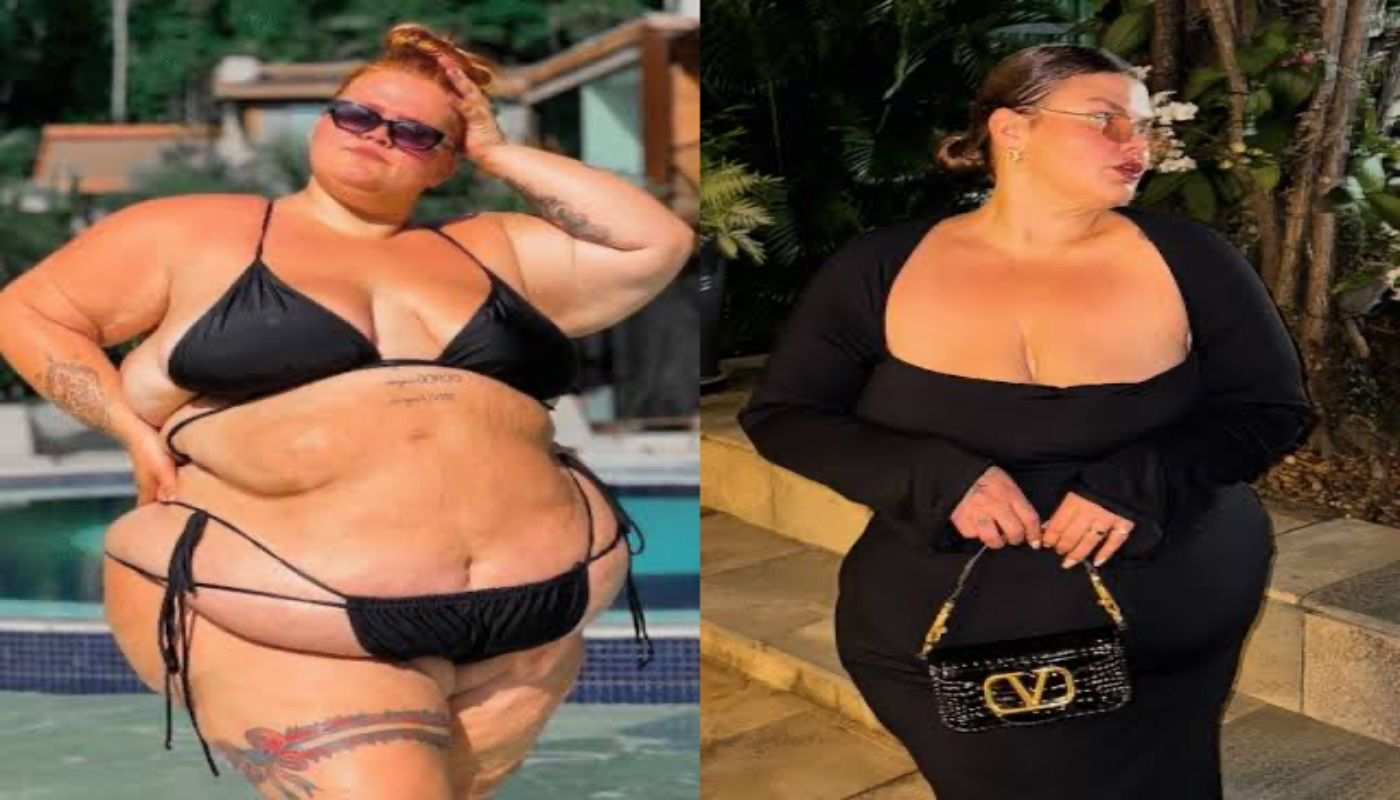
In 2017, she starred in a plus-size swimwear campaign and publicly celebrated being able to find swimwear in her size. The campaign placed her body in a context traditionally dominated by narrow beauty standards: the beach, the bikini and the language of sensuality.
That distinction is important.
Representation becomes more powerful when marginalized people are not merely represented as symbols of struggle.
A plus-size woman does not need to be photographed only discussing discrimination.
She can simply be beautiful.
She can wear a bikini.
She can participate in fashion.
She can dance.
She can flirt.
She can laugh.
She can take up space.
She can be photographed without the narrative immediately becoming “look how brave she is.”
This is one of the psychologically meaningful dimensions of inclusive representation.
When a person repeatedly sees bodies like their own participating in ordinary cultural experiences, the body can gradually become less associated with exclusion.
The psychological message changes from:
“People like me are exceptions.”
to:
“People like me belong here.”
That is a much deeper transformation.
From Representation to Permission
There is an important difference between representation and permission.
Representation means seeing someone who looks like you.
Permission is the feeling that you are allowed to participate in the same world.
Thaís Carla’s public image frequently operated at this second level.
Her content was not simply saying that larger women existed. Everybody already knew that.
The more disruptive message was that a larger woman could occupy the same cultural spaces traditionally associated with thinner bodies.
This is particularly significant in fashion.
Clothing communicates social belonging. The absence of suitable clothing is therefore not merely an inconvenience; it can become a form of exclusion.
In public interviews, Thaís has discussed the difficulty of finding clothing that accommodates larger bodies and has criticized the limited representation of plus-size models within major fashion environments.
Her observations reveal a larger problem.
Fashion frequently talks about individuality while being structurally selective about which bodies are given individual expression.
A person cannot fully participate in fashion if the industry does not consistently produce clothes for them.
This is why plus-size visibility cannot be reduced to hiring one curvier model for a campaign.
True inclusion involves the entire system:
- clothing availability
- size ranges
- fitting standards
- runway casting
- retail environments
- photography
- advertising
- media coverage
- social acceptance
- accessibility of physical spaces
Thaís Carla’s visibility helped expose the difference between being photographed occasionally and being accommodated systematically.
Why Her Work Matters Beyond Fashion
It would be easy to categorize Thaís Carla as a fashion or body-positive influencer.
That description is incomplete.
Her influence crosses several cultural industries because the body is never confined to one.
It appears in fashion.
It appears in dance.
It appears in entertainment.
It appears in healthcare.
It appears in relationships.
It appears in advertising.
It appears in public space.
It appears on social media.
That makes anti-fat prejudice particularly complicated. A person can experience it simultaneously through several institutions.
Thaís has publicly described experiences in which her body affected her ability to access ordinary spaces and services. She has also spoken about environments and equipment that were not designed with larger bodies in mind.
The significance of such accounts is not that every larger person will experience the same barriers.
Rather, they expose an important design principle:
When an environment is built around one body type, everyone outside that body type becomes responsible for adapting.
That is a structural problem rather than an individual failure.
Gordofobia as a Social, Not Merely Personal, Issue
One of Thaís Carla’s enduring contributions has been her insistence on discussing gordofobia as discrimination.
In interviews, she has described receiving comments that connected her body with assumptions about character, health, competence and worth. She has recalled being told that she would not dance professionally, succeed, marry or have children.
Her lived experience challenged those predictions.
This reveals a broader cultural mechanism.
Body stigma frequently works by turning appearance into a prediction.
A larger body becomes interpreted as evidence that someone is lazy.
Or undisciplined.
Or unhealthy.
Or unattractive.
Or unsuccessful.
Or lacking self-control.
These assumptions are socially powerful precisely because they often happen before a person has spoken.
Thaís has also described experiences in which strangers stared, whispered or reacted to her body before knowing anything about her. She has framed the issue as one of social marginalization and called for greater empathy.
The psychological consequences of this type of social judgment can be profound.
A person does not need to be directly insulted every day to learn that their body is being evaluated.
Repeated glances can communicate judgment.
A clothing store without appropriate sizes can communicate exclusion.
A chair that does not accommodate a larger body can communicate that the person was not anticipated.
A medical environment without appropriate equipment can communicate that the person’s body was treated as an exception.
Visibility therefore becomes more than representation.
It becomes evidence that society can recognize a wider range of bodies when designing public life.
The Psychological Power of Seeing Someone Refuse Shame
One of the most important dimensions of Thaís Carla’s influence lies in the emotional response her public presence can generate.
For people who have spent years associating their bodies with embarrassment, seeing someone openly inhabit a similar body can disrupt internalized shame.
This does not mean that one influencer can “cure” body insecurity.
It means representation can provide an alternative narrative.
Instead of:
“My body makes me unacceptable.”
the viewer may encounter:
“My body does not prevent me from participating.”
That distinction is enormous.
Body image is shaped not only by mirrors but by social feedback.
Children learn which bodies are praised.
Teenagers learn which bodies receive romantic attention.
Adults learn which bodies are considered professional, fashionable or socially acceptable.
Digital platforms intensify these lessons because users encounter thousands of curated bodies every day.
Within that environment, a creator like Thaís Carla introduces friction.
She interrupts the repetition of a single aesthetic ideal.
Her visibility tells audiences that the culturally “normal” body seen on screens is not the only body deserving of visual space.
The Difference Between Body Positivity and Body Neutrality
Thaís Carla’s career also offers an opportunity to reconsider the evolution of body-positive culture.
Early body-positive messaging often emphasized loving one’s body.
That message can be liberating.
But it can also become another expectation.
What happens when someone does not love their body every day?
What happens when someone feels insecure?
What happens when their relationship with appearance changes?
A more nuanced approach recognizes that dignity does not need to depend on constant self-love.
A person can have complicated feelings about their body while still believing that their body deserves respect.
This is particularly relevant when examining Thaís Carla’s public trajectory.
Her documented statements have emphasized confidence, dignity and resistance to gordofobia, while her more recent public discussions demonstrate that people’s relationships with their bodies can evolve over time.
That distinction is essential.
Body inclusivity should not demand permanent allegiance to one body size.
It should defend the person’s humanity across changes.
Her More Recent Public Journey Complicates the Body-Positive Narrative
Thaís Carla’s recent public evolution is particularly important because it challenges a simplistic interpretation of body positivity.
In 2025, she underwent bariatric surgery, and subsequent reporting documented changes in her body. In 2026, she discussed her evolving relationship with her body and self-care in public interviews.
For body-inclusivity conversations, the culturally important question is not whether an influencer remains at a particular size.
It is whether social acceptance is conditional upon size.
That is where Thaís’s story becomes especially revealing.
If society celebrates a larger woman only while she represents a particular political message, then that celebration is not genuine inclusion.
Likewise, if society becomes dramatically more accepting of someone only after their body changes, that reveals how strongly appearance continues to influence social treatment.
Thaís has publicly addressed this tension, explaining that her body was never the fundamental problem and discussing how social treatment changed after her body changed.
This is a critical lesson for body inclusivity.
The goal should not be to make every body fit one ideal. The goal should be to make dignity independent of conformity.
When Visibility Becomes More Than an Image
Influencer culture is sometimes dismissed as superficial because much of it revolves around photographs, clothing, beauty and lifestyle.
But images can carry political meaning.
A photograph communicates who belongs in the frame.
A bikini photograph communicates who is permitted to be sensual.
A fashion photograph communicates who deserves styling.
A dance video communicates which bodies are considered capable of movement.
A television appearance communicates who is worthy of mainstream attention.
Thaís Carla’s content therefore participates in a visual politics of belonging.
Her body is not simply being displayed.
It is being contextualized.
The same photograph can mean something very different depending on the cultural environment surrounding it.
When thin bodies dominate advertising, a plus-size body can be interpreted as an exception.
When diverse bodies become routine, the same image becomes ordinary.
This is why representation must eventually aim beyond novelty.
The ultimate achievement of inclusivity is not that people say, “Look, there is a plus-size woman.”
It is that people eventually stop treating her presence as remarkable.
Social Media as a Counter-Public Sphere
Traditional media has historically controlled visibility through editors, casting departments, publishers, advertisers and broadcasters.
Social media altered that equation.
Creators could build audiences before traditional institutions decided whether they were commercially desirable.
For marginalized bodies, this was especially significant.
A person who might have been rejected by mainstream fashion could create their own visual archive.
A person excluded from conventional advertising could collaborate with smaller brands.
A person ignored by television could speak directly to followers.
Thaís Carla emerged within this broader digital transformation.
Her social-media presence allowed conversations about body image to happen outside the conventional boundaries of lifestyle journalism.
The audience was no longer passive.
Followers could respond, share, challenge, support and reproduce the images.
This creates a form of networked visibility.
One woman’s photograph can become another woman’s permission to wear a swimsuit.
One dancer’s video can encourage another dancer to enter a studio.
One discussion about gordofobia can give language to an experience that previously felt individual.
That is one of the most powerful aspects of digital representation: it can transform isolated experiences into collective recognition.
The Legal and Cultural Dimension of Speaking Back
Thaís Carla’s activism has also moved beyond posting.
In 2021, she won a damages case against comedian Leo Lins over gordophobic comments, according to reporting at the time. She subsequently discussed the significance of challenging discriminatory speech and bringing greater attention to gordofobia.
The importance of such a moment extends beyond one dispute.
It demonstrates that online speech can have social consequences.
For years, derogatory comments about fat people were frequently dismissed as humor.
The logic was familiar:
“It is just a joke.”
“People are too sensitive.”
“She is famous; she should expect criticism.”
But challenging discriminatory language changes the cultural boundaries of what is considered acceptable.
This does not mean every criticism of a public figure is gordophobia.
Nuance matters.
A healthy public culture must distinguish between legitimate criticism and prejudice.
Yet that distinction becomes impossible when stereotypes are treated as harmless entertainment.
Thaís’s willingness to challenge such behavior contributed to a broader conversation about accountability in digital culture.
The Fashion Industry’s Unfinished Conversation
If Thaís Carla’s career demonstrates anything, it is that representation has advanced without becoming complete.
Her 2017 swimwear campaign was significant precisely because suitable plus-size swimwear was still something she had publicly discussed as difficult to find.
Years later, she continued publicly questioning the limited presence of plus-size models on major runways.
That gap reveals a recurring problem in the fashion industry.
Visibility can increase faster than infrastructure.
A brand may publish inclusive photographs without offering an extensive size range.
A magazine may feature a plus-size celebrity while maintaining narrow casting elsewhere.
A runway may include one larger model without changing its overall aesthetic philosophy.
This produces what could be called symbolic inclusion.
The image changes, but the system does not.
Authentic inclusion requires both.
The photograph matters.
The garment matters.
The casting matters.
The commercial commitment matters.
The customer experience matters.
Brazil and the Global Body-Image Conversation
Thaís Carla’s influence also deserves to be understood beyond Brazil.
Body ideals are global, but they are not identical.
Brazil has its own distinctive cultural relationship with the body, shaped by beach culture, carnival, dance, beauty industries, celebrity culture and highly visual social environments.
The Brazilian body is frequently celebrated as a source of national identity and sensuality.
Yet celebration can create its own pressure.
If the Brazilian ideal is associated with a particular silhouette, even a culture famous for bodily confidence can marginalize bodies that fall outside that silhouette.
Thaís’s visibility therefore exposes a fascinating contradiction:
A society can celebrate the body culturally while still policing which bodies are considered beautiful.
This is not uniquely Brazilian.
Similar contradictions exist around the world.
In the United States, plus-size activism has challenged fashion and media industries.
In Britain, body-image campaigns have confronted advertising standards and social-media pressures.
In parts of the Middle East, conversations about modesty, beauty, family expectations and social visibility intersect with changing fashion cultures.
Across South Asia, Bollywood, bridal fashion, social media and family expectations can create highly specific ideals surrounding women’s appearance.
Different cultures produce different versions of body pressure.
But the underlying question is remarkably similar:
Who gets to define the acceptable body?
Thaís Carla’s career contributes to the global answer by demonstrating that representation can be produced from within the community rather than handed down by cultural gatekeepers.
Why Dance Makes Her Case Especially Powerful
There is another reason Thaís Carla’s story stands out.
She did not build her visibility exclusively through posed photographs.
She is a dancer.
Movement changes the cultural meaning of the body.
A static image can be judged according to size.
Movement introduces skill.
Rhythm.
Technique.
Presence.
Power.
Expression.
A dancer asks the audience to look beyond the question of whether the body fits a visual ideal and toward what the body can communicate.
This is particularly disruptive in environments where larger bodies are frequently associated with limitation.
Dance offers a direct contradiction.
The body that society may describe through restrictions becomes a body capable of artistic expression.
That does not erase the realities of body stigma.
But it expands the cultural vocabulary available to the audience.
The larger body is no longer simply “large.”
It becomes expressive.
Professional.
Sensual.
Creative.
Dynamic.
Visible.
The Emotional Labor Behind Public Visibility
There is also a cost to becoming a highly visible representative of a marginalized group.
Once an individual becomes associated with a social movement, audiences can begin expecting them to embody its ideals perfectly.
That expectation is unfair.
Influencers are people, not permanent political symbols.
They can change their opinions.
Their careers can evolve.
Their bodies can change.
Their relationships can change.
Their interests can change.
Their priorities can change.
The expectation that a body-positive creator must remain visually unchanged can inadvertently reproduce the very body policing that body positivity seeks to challenge.
Thaís Carla’s evolving public life makes this contradiction particularly visible.
If her credibility depended entirely on remaining plus-size, then body acceptance would paradoxically become another form of appearance-based identity policing.
A more mature understanding of body inclusivity recognizes that people should not lose their right to dignity when their appearance changes.
The principle survives the transformation.
What Her Story Reveals About Internalized Beauty Standards
Thaís Carla has spoken publicly about being aware of body judgment from childhood and about growing up under restrictions surrounding food and appearance.
Her account illustrates how beauty standards become internalized.
A child does not need to read a fashion magazine to understand that certain bodies receive different treatment.
They observe relatives.
Classmates.
Teachers.
Television.
Clothing stores.
Photographs.
Compliments.
Insults.
Even jokes.
Eventually, cultural standards can become an internal voice.
The person begins monitoring themselves before anyone else has to.
“Is this dress too revealing?”
“Will people look at me?”
“Can I wear this?”
“Should I go to the beach?”
“Will people laugh?”
“Will I fit in that chair?”
That is why visibility matters psychologically.
It can weaken the assumption that public life belongs only to certain bodies.
A creator cannot remove another person’s insecurity, but she can provide evidence against the belief that insecurity is an unavoidable consequence of being larger.
From Individual Confidence to Collective Confidence
The most meaningful impact of a public figure is rarely measured only by follower numbers.
Cultural influence can be quieter.
It can happen when someone buys the swimsuit they previously avoided.
When someone attends a dance class.
When someone posts a photograph without editing their body.
When someone walks into a clothing store and asks for their size without apologizing.
When someone recognizes that being fat does not automatically make them less deserving of romance, fashion or professional respect.
These moments rarely become news stories.
But they are the foundation of cultural change.
Thaís Carla’s influence exists partly within these small acts.
Her public visibility gives audiences a reference point.
It tells them that another way of occupying the world is possible.
Representation Should Not Become a New Beauty Standard
There is an important warning here.
The body-positive movement can unintentionally replace one hierarchy with another.
If thinness is the old standard and “curvy” becomes the new fashionable ideal, people whose bodies do not fit either category remain excluded.
A genuinely inclusive culture cannot simply replace one preferred silhouette with another.
It must accommodate variation.
Tall bodies.
Short bodies.
Fat bodies.
Thin bodies.
Disabled bodies.
Aging bodies.
Bodies with scars.
Bodies that change over time.
Bodies that do not photograph neatly.
That is why Thaís Carla’s broader message about dignity is more valuable than any particular aesthetic.
The goal is not to establish the “perfect plus-size body.”
There should be no requirement for a plus-size woman to have an hourglass figure, a particular waist-to-hip ratio or a specific type of facial beauty to qualify for representation.
Otherwise, inclusivity becomes another beauty competition.
The Future of Plus-Size Visibility
The next phase of body inclusivity must move beyond individual influencers.
Creators like Thaís Carla can open the door.
Institutions have to walk through it.
Fashion brands need broader sizing.
Casting agencies need diverse talent pools.
Media companies need more varied bodies in ordinary roles.
Designers need to consider body diversity from the beginning rather than adding larger sizes as an afterthought.
Public spaces need to account for different bodies.
Healthcare environments need appropriate equipment and respectful treatment.
Digital platforms need to recognize how algorithmic beauty standards affect users.
Most importantly, society needs to stop treating visibility as a favor.
A larger person should not have to become inspirational simply to justify being seen.
They should not need a transformation story.
They should not need exceptional talent.
They should not need celebrity status.
They should not need to prove that they are healthy, successful, fashionable or confident.
Their humanity is enough.
Thaís Carla’s Most Lasting Contribution May Be the Right to Change
Perhaps the most interesting lesson of Thaís Carla’s public career is not that she represented one particular body.
It is that representation itself can evolve.
Her earlier work challenged the invisibility of fat women in fashion and entertainment.
Her conversations about gordofobia challenged prejudice.
Her dance career challenged assumptions about which bodies could perform.
Her social-media presence challenged traditional media gatekeeping.
Her more recent life demonstrates another important principle: body acceptance cannot depend upon permanent physical sameness.
That final point deserves emphasis.
A body-inclusive culture must make room for contradiction.
Someone can advocate against fat discrimination and make personal choices about their body.
Someone can love their body and still want to change aspects of their life.
Someone can be confident and insecure on different days.
Someone can be an activist without being perfect.
Someone can represent a movement without being obligated to remain unchanged forever.
This complexity does not weaken the body-positive conversation.
It makes it more human.
Conclusion: From Being Seen to Belonging
Thaís Carla’s impact on plus-size visibility cannot be measured simply by photographs, campaigns or follower counts.
Her deeper contribution lies in the cultural questions her visibility forces society to confront.
Why should a fat woman have to justify wearing a bikini?
Why should fashion determine which bodies deserve clothing?
Why should dance be associated with one physical silhouette?
Why should a person’s body become an assumption about their character?
Why should public spaces be designed around only one type of body?
And perhaps the most important question:
Why should anyone have to earn the right to be visible?
Thaís Carla’s career has unfolded within these contradictions.
She emerged from dance, an environment in which the body is simultaneously an artistic instrument and an object of intense scrutiny. She used digital media to bypass traditional barriers to representation. She participated in fashion campaigns that made plus-size sensuality visible. She spoke publicly about gordofobia and challenged discriminatory treatment. She became part of a broader Brazilian conversation about beauty, dignity and the politics of the body.
Her more recent public evolution adds another layer to that story.
It demonstrates that body inclusivity cannot be built around the assumption that a person’s body will remain unchanged. The ultimate test of an inclusive culture is whether dignity survives change.
That is where the future of body representation is heading.
The objective should no longer be merely to place a larger body in a photograph.
It should be to create a culture in which the body does not determine whether someone deserves the photograph in the first place.
Thaís Carla helped make the larger female body visible in spaces where it had often been treated as an exception.
The next step is more ambitious.
It is to make that visibility ordinary.
When a plus-size woman walking a runway is no longer considered a statement, when a fat dancer is evaluated for technique rather than surprise, when a bikini campaign does not require an explanation, and when people can change their bodies without losing their dignity, representation will have moved beyond symbolism.
It will have become belonging.
And that may be the most meaningful legacy of the body-inclusivity movement: not convincing society that every body is beautiful every minute of every day, but creating a world in which every body is allowed to live, participate, move, dress, work, love and exist without having to apologize for taking up space.
Sources: UOL Universa, Gshow, UOL Splash, CNN Brasil, Trip/Tpm, GNT, Record, Quem,