 by
by For decades, the global beauty conversation largely traveled in one direction: from Hollywood, European fashion houses, and Western advertising outward. The archetypes were familiar—bronzed skin, sculpted cheekbones, fuller lips, dramatic contouring, overtly sexualized femininity, and an increasingly polished version of individualism.
Then something changed.
A teenager in Los Angeles could begin a morning skincare routine inspired by a Korean idol. A university student in London could search for aegyo-sal makeup tutorials. A young consumer in Toronto could purchase a Korean cushion foundation because she had seen it used by a K-pop performer. On TikTok, a beauty look developed for a Korean stage could be recreated thousands of miles away by people whose facial features, skin tones, cultural backgrounds, and beauty histories may be completely different.
The influence of Korean idol beauty is therefore bigger than K-pop itself.
It represents a significant shift in who gets to define what beauty looks like—and where those definitions originate.
The phenomenon sits at an interesting intersection of admiration, commerce, cultural exchange, aspiration, algorithmic influence and body politics. Korean idols have introduced Western youth to aesthetics that can feel markedly different from traditional Western glamour: luminous skin instead of heavy foundation, blurred lips instead of sharply outlined ones, softly defined eyes, youthful styling, carefully constructed “natural” makeup, delicate color palettes and an emphasis on skincare as part of beauty rather than merely preparation for it.
Yet the story is not simply that Korean beauty has liberated young Western consumers from Western beauty standards.
Korean idol culture carries its own demanding visual conventions. Research into K-beauty has identified tensions between “manufactured naturalness,” cuteness and highly controlled femininity, demonstrating that an aesthetic can appear effortless while requiring considerable labor behind the scenes.
For Western youth, Korean idol beauty can consequently function as both an alternative and another standard to measure themselves against.
Understanding that contradiction is essential.
From Western Export to Global Beauty Exchange
The international rise of Korean popular culture has fundamentally altered the geography of cultural influence.
K-pop and Korean dramas did not merely become entertainment consumed abroad. They became vehicles through which fashion, cosmetics, hairstyles, skincare practices and ideas about presentation traveled internationally.
Beauty was particularly well suited to this process because it could be copied.
A song requires language and musical familiarity. A television drama requires sustained viewing. But a makeup technique can be learned in thirty seconds.
A hairstyle can be recreated from a screenshot.
A lip tint can be ordered online.
A skincare ingredient can become a TikTok recommendation overnight.
This made Korean beauty unusually adaptable to digital youth culture.
Research examining Western beauty standards on TikTok has specifically identified K-beauty influencers as part of a broader transformation in how beauty ideals circulate through social media. Rather than beauty standards moving exclusively from Western media outward, young audiences increasingly encounter multiple cultural aesthetic systems simultaneously.
This is an important cultural development.
The Western teenager encountering Korean idol beauty is not necessarily abandoning Western beauty. She may be combining influences.
A Korean-inspired eye look might be paired with American lip liner. A Korean cushion foundation might be worn with Western-style bronzer. Glass-skin techniques might coexist with a distinctly Western preference for dramatic lashes.
The result is not cultural replacement.
It is cultural mixing.
Why Korean Idol Beauty Feels Different
One reason Korean idol aesthetics have attracted Western youth is that they often communicate a different relationship with femininity and masculinity.
Traditional Western beauty marketing has frequently emphasized transformation: sculpt the face, define the cheekbones, enlarge the lips, conceal imperfections and create stronger visual contrast.
Korean idol beauty often emphasizes refinement rather than dramatic transformation.
The goal can be to make skin look translucent, eyes appear brighter, lips appear naturally flushed and facial features look harmonious.
That distinction matters psychologically.
A young person may interpret a heavily contoured face as something that requires changing the architecture of their appearance. By contrast, a soft Korean-inspired makeup style can feel like an invitation to enhance what is already there.
Of course, the distinction is not absolute.
Korean idol appearances are meticulously produced. Professional makeup artists, hairstylists, lighting, photography, styling, editing and coordinated fashion all contribute to the finished image.
But the visual language frequently communicates effortless beauty.
That paradox is one of the most powerful parts of the aesthetic.
Academic research on K-beauty has described this tension as “manufactured naturalness”: an appearance designed to look natural even though substantial cultural and aesthetic labor may be involved.
For young Western consumers, that creates a new beauty aspiration:
not “I want to look heavily made up,” but “I want to look naturally perfect.”
And that difference has consequences.
The Rise of “Natural” Beauty That Is Anything But Simple
The phrase “natural makeup” has become increasingly popular across Western social media, but Korean idol culture has helped redefine what naturalness can mean.
A Korean-inspired natural look may involve several layers of skincare, complexion products, concealer, subtle contouring, blush, gradient lip color, brow shaping, eye definition and strategic highlighting.
The final result may appear barely there.
The process is not.
This creates a fascinating contradiction for body-inclusivity discussions.
On one hand, Korean beauty can challenge the assumption that beauty must mean obvious glamour. It can normalize softer presentation, delicate colors and skin-focused routines.
On the other hand, it can make perfection appear deceptively achievable.
If a teenager sees a flawless idol with luminous skin and interprets that appearance as “natural,” she may not recognize how much professional styling and image production went into creating it.
This is not an argument against Korean beauty.
It is an argument for media literacy.
Young consumers need to understand that an aesthetic can be beautiful without being a realistic baseline for everyday life.
The Idol as Beauty Educator
K-pop idols occupy an unusual position in contemporary youth culture.
They are performers, fashion figures, brand ambassadors and increasingly informal beauty educators.
A makeup tutorial can turn an idol’s personal routine into a global lesson.
A backstage video can introduce millions of viewers to a Korean product.
A beauty interview can turn a previously unfamiliar technique into a mainstream Western trend.
A recent example is Katseye member Yoonchae, who has discussed her evolving makeup routine in Vogue’s Beauty Secrets. The Korean-born performer, who moved to the United States, demonstrated techniques including contouring and aegyo-sal makeup while explaining how she modifies her appearance for different contexts.
The significance lies not simply in the products she uses.
It is in the educational relationship.
A young Western viewer is not necessarily encountering Korean beauty through an advertisement anymore. She may encounter it through a person whose personality, humor, routine and creative choices feel accessible.
That makes beauty instruction more intimate.
The idol becomes a cultural translator.
Aegyo-Sal and the Expansion of What Eyes Are Supposed to Look Like
One particularly interesting example is aegyo-sal.
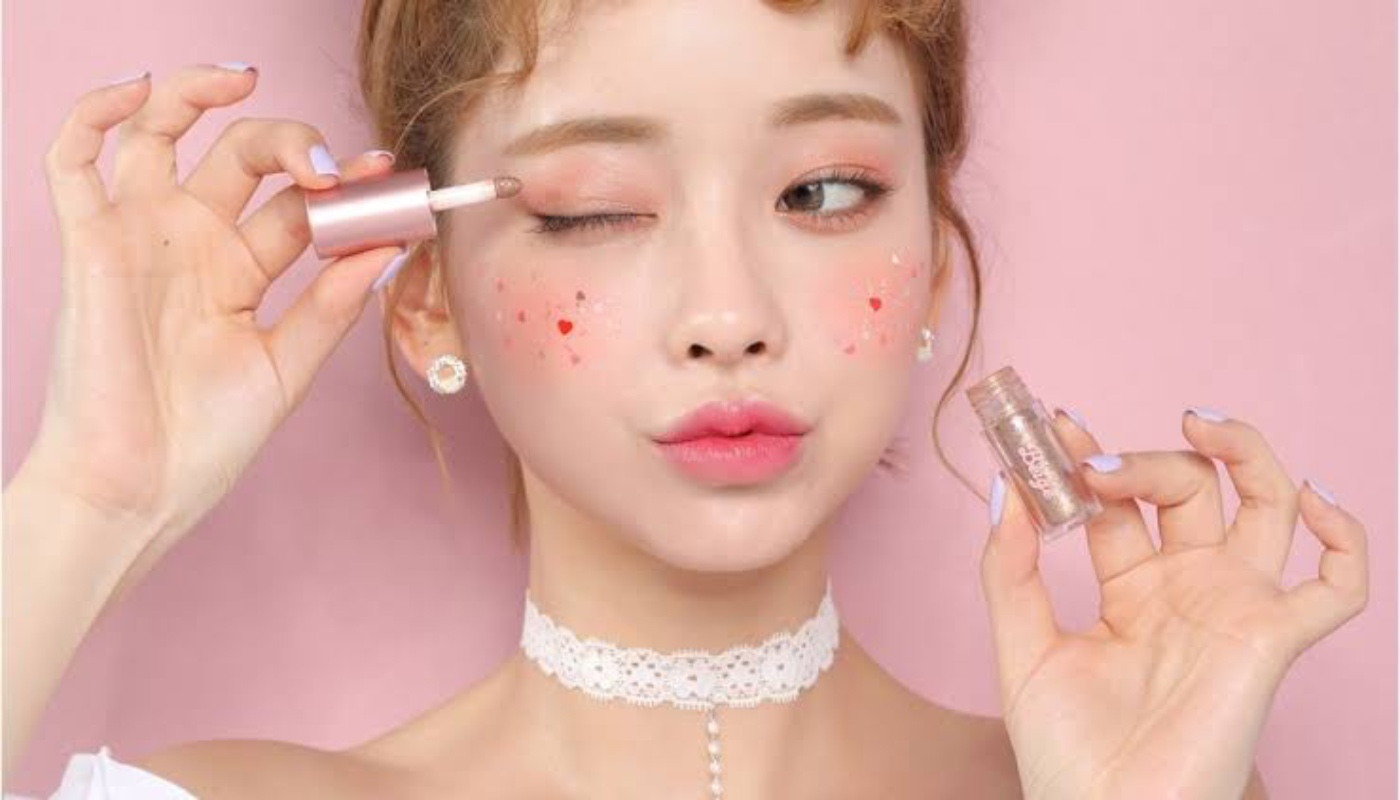
The technique emphasizes the small area beneath the lower lash line to create a youthful, bright-eyed effect. It is not simply another eyeliner trend; it reflects a different aesthetic interpretation of the eye area.
Western makeup traditions have often emphasized eliminating shadows beneath the eyes.
Korean makeup can sometimes do the opposite by deliberately emphasizing a natural-looking under-eye feature.
This illustrates something larger about cultural exchange:
Beauty standards are not universal truths.
They are systems of interpretation.
The same facial feature can be minimized in one culture and highlighted in another.
When Western teenagers discover these differences, they are exposed to a broader vocabulary for interpreting their own faces.
That can be liberating.
Instead of thinking, “This feature is objectively unattractive,” they may begin to ask, “Why was I taught to see this feature that way?”
That question is culturally powerful.
The Skin-Care Revolution Behind Idol Beauty
Perhaps no aspect of Korean beauty has traveled further into Western youth culture than skincare.
The idol aesthetic places enormous visual emphasis on complexion.
But the cultural shift is not simply about wanting clearer skin.
It is about turning skincare into a visible lifestyle.
In many Western beauty routines, skincare historically operated behind the scenes. Makeup was the public-facing transformation.
K-beauty helped popularize the idea that skincare itself could become a pleasurable ritual and a central part of beauty culture.
Hydration, sunscreen, gentle cleansing, essences, serums and layered textures became familiar concepts to younger Western consumers.
Current beauty coverage continues to show the strong international presence of Korean skincare, while newer Korean trends are increasingly positioned alongside clinical and pharmacy-oriented approaches rather than being limited to the earlier “10-step routine” stereotype.
This shift has an important cultural implication.
Beauty becomes less about covering the body and more about caring for it.
That can be particularly meaningful for young people who have grown tired of constant transformation culture.
However, skincare can also become another form of perfectionism if every pore, mark or texture becomes treated as a problem requiring correction.
The healthiest interpretation is not:
“Perfect skin is necessary for beauty.”
It is:
“Skin deserves care even when it remains human.”
When Korean Beauty Becomes a Counterpoint to Eurocentric Beauty
The cultural significance becomes even more complicated when Korean beauty is compared with longstanding Eurocentric standards.
For decades, Western media exported beauty ideals around the world. Lighter skin, narrow facial proportions, particular eye shapes, body silhouettes and Western fashion aesthetics often acquired disproportionate cultural status.
Korean popular culture disrupts that hierarchy because it gives global audiences a non-Western beauty system with enormous commercial and cultural visibility.
Research on K-beauty in Southeast Asia has found that Korean beauty can be perceived as a more relatable alternative to Westernized ideals while simultaneously raising concerns about colorism and new hierarchies involving Korean beauty imagery.
That contradiction deserves attention.
Replacing one dominant beauty hierarchy with another is not the same as eliminating hierarchy.
If a young person moves from believing “Western beauty is the universal ideal” to believing “Korean beauty is the universal ideal,” the fundamental problem remains.
True cultural diversity requires something more expansive.
It means allowing Korean beauty to exist alongside Black beauty, South Asian beauty, Arab beauty, Indigenous beauty, Latin American beauty, Southeast Asian beauty and countless individual interpretations without requiring one aesthetic to become the new global standard.
Western Youth Are Not Passive Consumers
It would be simplistic to suggest that Western teenagers simply absorb Korean beauty standards.
Young audiences interpret culture.
They remix it.
They reject parts of it.
They exaggerate others.
They adapt trends to their own faces.
A Western teenager may love Korean gradient lips while rejecting the expectation of ultra-light complexion makeup. Another may adopt Korean skincare while maintaining her own cultural relationship with hair and cosmetics.
This is where globalization becomes more interesting than cultural imitation.
The consumer becomes a co-creator.
Social platforms accelerate this process because trends are rarely consumed in their original form. A Korean technique can be explained by an American creator, recreated by a British teenager, adapted by a Nigerian beauty influencer and eventually marketed by a global cosmetics company.
By then, the origin may become almost invisible.
The trend has become transnational.
The Psychological Appeal of Idol Beauty
Beauty standards influence more than shopping habits.
They can influence self-perception.
A 2024 study of adolescents in Shillong, India, found that exposure to K-pop beauty standards was associated with reported feelings of inadequacy and pressure among participants, while social media amplified the circulation of those ideals.
The finding should not be interpreted as evidence that K-pop automatically harms young people.
Rather, it demonstrates why context matters.
A teenager who encounters an unfamiliar beauty aesthetic may feel inspired.
Another may feel inadequate.
The same image can produce completely different psychological reactions.
This depends on factors such as self-esteem, social environment, frequency of exposure, peer culture and how literally the viewer interprets the image.
The algorithm adds another layer.
If someone watches one Korean makeup tutorial, the platform may offer another, then another, until the aesthetic becomes the dominant visual language in that person’s feed.
What began as curiosity can become repetition.
And repetition can create familiarity.
Familiarity can eventually feel like normality.
The Algorithm Turns Beauty Into a Feedback Loop
This is one of the most important differences between contemporary Korean idol influence and earlier forms of celebrity culture.
A magazine cover appeared once.
A television advertisement ran at scheduled intervals.
Social media beauty content does not disappear.
It follows the user.
The more a young person interacts with Korean beauty content, the more similar content recommendation systems may provide. The result can be an increasingly narrow visual environment.
This phenomenon is not unique to K-pop.
The same algorithmic mechanism can amplify Western contouring, body trends, cosmetic procedures, fitness aesthetics or any other visual ideal.
But Korean idol culture demonstrates how quickly a culturally specific aesthetic can become globally normalized.
Research into algorithmic beauty culture has increasingly highlighted how social media recommendation systems and beauty filters can contribute to the construction of standardized aesthetic preferences rather than simply reflecting existing preferences.
The question, therefore, is no longer merely:
“Who is influencing young people’s beauty standards?”
It is also:
“What does the platform keep showing them?”
The Body Inclusivity Question
For a publication concerned with body inclusivity, the Korean idol phenomenon raises a difficult but necessary question:
Can an aesthetic movement be culturally groundbreaking while still presenting restrictive ideals?
The answer is yes.
Cultural progress is rarely perfectly consistent.
Korean beauty has challenged Western dominance while also carrying its own expectations around complexion, facial proportions, youthfulness and polished presentation. Contemporary scholarship has examined how K-pop beauty standards can reproduce exclusion and social hierarchies within and beyond Korea.
Recognizing that does not require dismissing Korean culture.
It requires separating cultural appreciation from aesthetic obedience.
A young person can admire an idol’s makeup without believing her own face should resemble that idol’s.
She can enjoy Korean skincare without treating every pore as a failure.
She can recreate an aegyo-sal look without believing her natural eye shape needs correction.
She can love K-pop fashion while rejecting the idea that thinness, youth or facial symmetry determines worth.
That distinction is the foundation of healthier cultural consumption.
The South Asian Perspective
The conversation becomes particularly relevant outside the West.
Korean beauty has developed a substantial following among South Asian youth, where existing beauty cultures already contain complicated histories involving skin color, class, colonialism, fairness products and Westernized appearance ideals.
A 2022 study examining Pakistani youth aged 15 to 29 found widespread consumption of South Korean media and reported acceptance of Korean beauty standards among participants.
This is culturally significant because Korean beauty can simultaneously represent difference and familiarity.
It is not Western.
Yet it is modern, global, highly commercialized and digitally accessible.
For some South Asian consumers, Korean beauty can therefore feel like an alternative to Western beauty while still fitting comfortably into a global aspirational culture.
But this is precisely why critical thinking matters.
If Korean beauty becomes associated with lighter skin, particular facial proportions or highly controlled femininity, it can interact with pre-existing colorism rather than dismantling it.
Cross-cultural beauty exchange should expand possibilities, not replace one hierarchy with another.
The Appeal of Softness
Another reason Korean idol beauty resonates with Western youth is its relationship with softness.
The aesthetic can combine femininity with playfulness.
Pastel colors, glossy lips, softly flushed cheeks, delicate accessories, youthful hairstyles and understated eye makeup create a visual language that differs from the aggressive glamour associated with some Western beauty eras.
This matters because young people do not necessarily want to look older, harder or more overtly sexualized.
For some, softness feels empowering precisely because it offers another way of being visible.
At the same time, softness should not become another compulsory feminine performance.
There is nothing inherently more authentic about looking delicate.
The culturally useful lesson is simply that multiple expressions of femininity can coexist.
What Happens to Masculinity?
The Korean idol influence also complicates Western ideas about male beauty.
K-pop has made skincare, styled hair, jewelry, carefully coordinated clothing and visible grooming more familiar components of male celebrity presentation for international audiences.
This matters because Western masculinity has historically contained stronger expectations around ruggedness and minimal cosmetic involvement.
Korean idol culture offers a different possibility:
A man can care about his skin.
He can experiment with fashion.
He can wear makeup.
He can pay attention to hair.
He can present himself as polished without necessarily abandoning masculinity.
For young Western men, that can expand the acceptable boundaries of self-presentation.
The impact is therefore not restricted to teenage girls.
It is part of a broader redefinition of who is permitted to care about appearance.
The Commercial Power of the Idol Face
There is also an economic dimension.
Beauty companies understand that idols do more than model products.
They create aspiration.
When a celebrity associated with a particular visual identity becomes attached to a cosmetics or fashion campaign, the cultural credibility of that identity can translate into consumer interest.
The idol becomes a bridge between entertainment and commerce.
This is one reason the beauty industry has increasingly treated Korean celebrities as global cultural figures rather than regional endorsers.
Yet commercialization creates a new question:
Where does cultural influence end and consumer pressure begin?
When every beauty trend is attached to a product, young people can easily receive the message that self-expression requires purchasing something.
Aesthetic discovery can therefore become consumption.
That does not invalidate the cultural exchange.
It simply means young audiences should be encouraged to distinguish between liking an aesthetic and buying everything associated with it.
Beauty as Cultural Curiosity
One of the most positive possibilities of Korean idol influence is that beauty can become an entry point into broader cultural curiosity.
A young person might begin with K-pop makeup and eventually become interested in Korean language, food, history, cinema, fashion or contemporary culture.
Beauty can function as a doorway.
But cultural appreciation is strongest when it moves beyond aesthetics.
Korea should not be reduced to glass skin, idols and cosmetics any more than India should be reduced to Bollywood, Pakistan to bridal fashion or France to perfume.
A culture is larger than its exportable aesthetics.
The challenge for global audiences is to enjoy cultural products without flattening the culture that produced them.
The Risk of “Koreanizing” Individual Faces
One of the more concerning developments in online beauty culture is the language of transformation.
Tutorials can subtly suggest that users should recreate not simply a makeup style but an entire facial aesthetic.
This is where inspiration can cross into dissatisfaction.
There is a meaningful difference between:
“I love this makeup technique.”
and:
“I wish my face naturally looked Korean.”
The first is cultural experimentation.
The second can reflect the internalization of a racialized beauty hierarchy.
This is particularly important for young people because adolescence and early adulthood are periods in which identity is still being negotiated.
The goal of global beauty culture should not be to encourage young people to erase their cultural features.
It should help them experiment without teaching them that their original appearance is a problem.
The Future Is Likely to Be Hybrid
The next stage of beauty culture will probably not belong exclusively to Korea, the United States or any other single cultural center.
It will be hybrid.
Western youth are already combining Korean skincare, South Asian bridal-inspired color, African beauty techniques, Japanese minimalism, Middle Eastern fragrance culture and Western makeup trends.
Digital platforms make these combinations increasingly ordinary.
The future beauty consumer is therefore less likely to ask:
“Which culture has the correct beauty standard?”
and more likely to ask:
“What can I take from each aesthetic and make my own?”
That is potentially a healthier direction.
But hybridity should not mean cultural extraction without recognition.
The creators, histories and communities behind beauty practices deserve visibility.
Moving From Idol Perfection to Individual Expression
Korean idol beauty has undeniably changed the global beauty conversation.
It has challenged the assumption that Western aesthetics are the only universal reference point. It has introduced millions of young consumers to new approaches to skincare, makeup, grooming and self-presentation. It has expanded ideas about softness, masculinity, femininity and visual expression.
But its influence should not be measured only by how many people buy Korean cosmetics or recreate idol makeup.
Its deeper cultural impact lies in the questions it has made possible.
Why must beauty have one center?
Why should one facial structure be considered universally desirable?
Why is one version of femininity more legitimate than another?
Why should “natural” beauty have to look professionally perfected?
And perhaps most importantly:
Can we admire someone else’s beauty without turning it into a requirement for ourselves?
That is the distinction that will determine whether global beauty exchange becomes liberating or simply produces a new hierarchy.
Korean idol beauty does not need to become less Korean to be inclusive. Western youth do not need to reject it to protect their identities. The more productive future is one in which Korean aesthetics remain culturally recognizable while young people are free to adapt, remix, reject or reinterpret them according to their own identities.
The next generation does not need a single beauty ideal.
It needs a larger beauty vocabulary.
And perhaps that is the most valuable legacy of Korean idol influence: not that young people around the world have learned how to look Korean, but that they have learned beauty can come from somewhere other than the traditional cultural centers that once claimed the authority to define it.
The future of inclusive beauty will not be about finding a new “perfect” face.
It will be about making room for more faces.
Sources: Vogue, ELLE, International Journal of Social Science Humanity & Management Research, International Journal of Indian Psychology, Monash University, SAGE Journals, Frontiers in Communication, ScienceDirect, Korean Citation Index, Indiana University ScholarWorks