 by
Introduction: When the Dream Dress Comes With a Size Restriction
For generations, the wedding dress has represented far more than an outfit. It is a cultural symbol, an expression of identity, a family heirloom in the making, and, for many people, one of the most emotionally significant garments they will ever wear. Whether it is an elaborate white couture gown, a traditional red lehenga, an intricately embroidered sharara, or a minimalist contemporary wedding dress, bridal fashion carries expectations that extend well beyond aesthetics.
Yet there is an uncomfortable contradiction at the heart of this industry. Weddings are celebrations of love, individuality, family, and personal milestones, but the fashion industry responsible for dressing brides has historically struggled to accommodate the diversity of the people getting married.
While mainstream fashion, sportswear, lingerie, and even luxury ready-to-wear have made increasingly visible efforts toward extended sizing, bridal fashion remains considerably more restrictive. Brides outside conventional sample sizes frequently encounter limited selections, inaccessible boutiques, complicated alterations, and campaigns that rarely reflect their bodies. Even when designers technically offer extended sizing, finding a physical sample to try on can become an entirely different challenge.
The problem is not simply that some wedding dresses are unavailable in larger sizes. It is that the entire bridal shopping experience has traditionally been organized around a narrow understanding of what a bride should look like.
This distinction matters because bridal fashion is uniquely personal. A bride is not merely purchasing clothing for an ordinary occasion. She is navigating family expectations, cultural traditions, financial commitments, public visibility, and deeply personal emotions. When the industry makes her feel that her body is an inconvenience rather than a legitimate customer consideration, the consequences extend beyond fashion.
The slow adoption of size inclusivity in bridal fashion reveals how deeply traditional beauty standards remain embedded in commercial institutions. It also raises a larger question: If the wedding industry celebrates every love story, why has it taken so long to celebrate every body?
1. Bridal Fashion Has Inherited a Narrow Definition of the Ideal Bride
The bridal industry did not develop independently of wider beauty culture. Its visual language emerged from generations of fashion traditions, social expectations, and commercial ideas about femininity.
In Western bridal imagery, the ideal bride has frequently been represented through a particular silhouette: a relatively narrow waist, a defined upper body, delicate proportions, and an overall appearance associated with conventional fashion-model standards.
This image became especially influential through luxury bridal advertising, fashion magazines, designer presentations, and celebrity wedding coverage.
The problem is not that slender brides are represented. They deserve to see themselves celebrated, too. The problem arises when one body type becomes the default representation of bridal beauty.
Other bodies consequently become secondary considerations.
A similar dynamic exists in many South Asian bridal markets, although the visual expectations differ. Pakistani and Indian bridal fashion often emphasizes elaborate embroidery, dramatic silhouettes, fitted bodices, voluminous lehengas, structured dupattas, and carefully coordinated accessories.
The ideal bridal image is frequently constructed around a highly stylized silhouette, with particular attention given to the waist, shoulders, neckline, and overall proportions.
These aesthetics are not inherently exclusionary. Traditional craftsmanship and elaborate silhouettes can be beautiful on bodies of different sizes. However, when designers repeatedly develop their collections around a narrow range of measurements, the result is an industry that struggles to translate its artistic vision across different body types.
In both Western and South Asian markets, the underlying issue is similar: the industry has historically treated a particular silhouette as its starting point rather than designing from the beginning with bodily diversity in mind.
Changing that assumption requires more than introducing additional sizes. It requires reconsidering who the industry imagines when it creates a wedding collection.
2. The Sample Size System Creates an Invisible Barrier
One of the most significant structural obstacles to size inclusivity is the bridal sample system.
Unlike ordinary ready-to-wear fashion, wedding dresses are frequently produced through made-to-order arrangements. Bridal boutiques typically purchase a limited number of sample gowns from designers so customers can examine the construction, fabric, detailing, and overall silhouette before placing an order.
These samples are expensive.
A boutique cannot necessarily purchase every design in every available size. Consequently, stores often prioritize a relatively narrow range of samples that they believe will attract the largest number of customers.
This creates an immediate problem for brides who fall outside the sizes represented in the showroom.
A designer might technically manufacture a dress in an extended size range, but that does not mean a bride can physically try it on.
The distinction between availability and accessibility is fundamental.
A dress existing in a manufacturer’s catalogue does not guarantee that it exists in a size that allows every customer to experience it properly.
The Knot explored this problem in its reporting on size inclusivity at bridal fashion week. Its coverage highlighted how limited sample availability affects the entire purchasing process, from designers and retailers to the customers ultimately entering boutiques.
The publication also documented how the industry can become trapped in a cycle: designers hesitate to produce larger samples because retailers do not order them, while retailers hesitate to order them because designers do not sufficiently showcase extended-size collections.
The customer becomes the person who absorbs the consequences of this commercial hesitation.
This is particularly revealing because it demonstrates that exclusion is not always the result of one individual’s prejudice.
It can also emerge through ordinary business decisions that collectively produce an unequal shopping environment.
When the same assumptions influence manufacturing, retail purchasing, fashion presentations, and advertising, limited representation becomes institutionalized.
3. Why Made-to-Order Does Not Automatically Mean Inclusive
The bridal industry frequently presents customization as one of its greatest advantages.
Unlike mass-produced clothing, wedding dresses can often be adjusted to accommodate individual measurements. Some designers offer custom sizing, personalized construction, and alterations that allow brides to achieve a more individualized fit.
However, customization should not be confused with genuine size inclusivity.
A garment can be technically available through custom ordering while remaining difficult to access in practice.
For example, a bride may find a dress online, love its silhouette, and discover that the designer accepts measurements outside the standard size chart. Yet she might not find a local boutique carrying the design in a sample size that allows her to understand how it will look and feel.
She may be expected to make a substantial financial commitment without having experienced the garment properly.
This creates additional uncertainty.
A photograph cannot communicate everything about a wedding dress. The weight of its fabric, the placement of its structure, the comfort of its bodice, the way its skirt moves, and the support provided by its internal construction all become apparent through physical fitting.
For a bride who requires more extensive alterations, these details can be especially important.
There is also a distinction between adjusting a pattern and genuinely designing for different bodies.
Simply enlarging a smaller pattern does not necessarily produce a well-fitting garment. Proportions change, fabric behaves differently, and structural elements may require reconsideration.
A larger bodice might need different support. A waist seam may need repositioning. Lace placement, boning, straps, sleeves, and closures may require individual attention.
Vogue’s 2026 reporting on size inclusivity in bridal fashion highlighted precisely this issue. Designers and bridal professionals discussed the importance of considering patterning, support, and construction rather than treating extended sizing as a simple exercise in enlarging an existing design.
The industry must therefore recognize that inclusive design is a technical discipline, not simply a larger number printed on a size chart.
4. Bridal Shopping Is an Emotional Experience, Not an Ordinary Retail Transaction
The psychological consequences of exclusion become particularly significant because wedding dress shopping carries enormous emotional expectations.
For many brides, choosing a wedding dress is an experience they have imagined since childhood. It might involve mothers, sisters, friends, partners, or other important family members.
There are photographs, appointments, conversations, and expectations surrounding the occasion.
Popular culture has reinforced the idea that finding the perfect dress should be an unforgettable moment.
Television programmes, wedding films, social media videos, and bridal advertisements frequently portray the fitting room as a place of excitement, tears of happiness, and emotional discovery.
However, that experience becomes more complicated when the bride cannot find dresses that accommodate her body.
Imagine entering a boutique after weeks of researching designers and saving inspiration photographs. You have identified several dresses that reflect your personal taste. Yet when you arrive, the available samples do not fit.
Instead of exploring different necklines, fabrics, silhouettes, and embellishments, the appointment becomes a discussion about what might be possible after extensive alterations.
The emotional focus shifts.
Rather than asking which dress makes her feel most like herself, the bride may begin wondering which dress is easiest to accommodate.
This difference can influence confidence, enjoyment, and the way someone remembers an important milestone.
The Knot’s research into bridal shopping experiences has documented differences between brides of different sizes. Its 2019 size-inclusivity research found that approximately one-third of brides size 12 and above experienced difficulty finding dresses in or near their size. More than 60% indicated that a larger selection of appropriately sized dresses could have improved their shopping experience.
These findings demonstrate that access is not a minor retail inconvenience.
It directly influences how customers experience one of the most emotionally significant purchases of their lives.
5. The Pressure to Become a Different Bride Before the Wedding
Another reason bridal fashion remains culturally complicated is its relationship with the idea of the wedding body.
The phrase “shedding for the wedding” has become familiar across popular culture and social media.
It describes the expectation that brides should pursue physical transformation before their wedding day, often presenting the occasion as a deadline for achieving a particular appearance.
The concept can appear in fitness content, bridal magazines, beauty discussions, influencer posts, and commercial marketing.
Although preparing for a wedding can involve personal wellness goals, the cultural problem emerges when physical transformation becomes an assumed requirement.
The bride is encouraged to think about how she should look rather than how she wants to feel.
This creates a particularly uncomfortable contradiction for size-diverse customers.
An industry that does not consistently offer adequate samples in extended sizes can indirectly reinforce the idea that the customer must adapt to the industry instead of expecting the industry to accommodate her.
The Knot’s reporting on bridal fashion week has examined the relationship between conventional beauty ideals, social media, and the continuing pressure to pursue pre-wedding body transformations.
This pressure is not experienced equally by everyone.
Some brides enjoy preparing for their wedding through exercise, skincare, styling, or other personal routines. Others may feel entirely comfortable maintaining their existing appearance.
Neither experience should be judged.
The concern is the assumption that a bride’s body is a project requiring completion before she deserves to feel beautiful.
A genuinely inclusive bridal industry would separate wedding preparation from compulsory physical transformation.
It would allow a bride to choose her dress according to her actual body, personal preferences, and comfort rather than an imagined future version of herself.
6. The Financial Consequences of Limited Size Availability
Size exclusion also has a significant economic dimension.
Wedding dresses are already expensive purchases. Depending on the designer, fabric, construction, embellishments, and level of customization, prices can vary dramatically.
When extended-size options are limited, customers may face additional expenses.
These can include:
- Specialized alterations.
- Custom pattern development.
- Additional fittings.
- International shipping.
- Travel to more inclusive boutiques.
- Reworking structural elements.
- Purchasing supportive undergarments specifically suited to the garment.
Not every extended-size bride experiences all these expenses, and customization is not inherently negative. However, the lack of readily available options can make the process more expensive and time-consuming.
This creates an important question of fairness.
Why should customers have to pay additional amounts simply because the standard retail infrastructure does not adequately represent their measurements?
The problem becomes even more complicated when brides are working with fixed wedding budgets.
In many cultures, wedding expenses involve contributions from several family members. A dress may be purchased months before the ceremony, and the financial commitment is often connected to other major expenses.
If the only suitable option requires additional customization, the bride may have to compromise elsewhere.
Inclusivity therefore affects more than representation. It affects purchasing power.
The industry cannot meaningfully claim to offer universal bridal fashion if accessibility depends on whether a customer can afford to overcome its limitations.
7. South Asian Bridal Fashion: When Tradition Meets the Size Question
The global conversation about bridal inclusivity must extend beyond Western wedding gowns.
South Asian bridal fashion provides an especially important perspective because wedding clothing carries deep cultural, familial, and ceremonial significance.
In Pakistan, India, Bangladesh, and other South Asian communities, bridal fashion frequently involves elaborate garments that are closely connected to regional identities and traditions.
Pakistani bridal wear includes lehengas, ghararas, shararas, heavily embroidered frocks, pishwas, and contemporary interpretations of traditional ensembles.
Indian bridal fashion encompasses an equally broad range of regional aesthetics, from Banarasi silk saris and Kanjeevaram drapes to lehengas, shararas, and elaborate contemporary couture.
These garments are not simply decorative outfits.
They can represent family heritage, regional craftsmanship, religious traditions, social status, and personal identity.
Yet cultural richness does not automatically guarantee inclusive sizing.
In fact, elaborate bridal construction can make fitting more complicated.
A heavily embroidered blouse, for instance, requires careful consideration of measurements, structural support, sleeve placement, and neckline proportions.
A lehenga’s waist placement and skirt construction influence how the entire ensemble sits on the body.
Similarly, a dupatta may require particular attention to draping, weight distribution, and attachment points.
When designers rely on a limited range of standard patterns, brides with different proportions may find that the garment requires substantial reconstruction.
The issue is not that traditional silhouettes should change to accommodate every possible preference.
It is that traditional craftsmanship should be accessible across a wider range of bodies.
Pakistan’s Bridal Fashion Conversation
Pakistan’s bridal fashion market is particularly interesting because it operates through a combination of designer labels, couture ateliers, established boutiques, independent tailors, and customized wedding outfits.
Customization is already an important part of the market.
Many brides have garments created according to individual measurements rather than purchasing standardized ready-to-wear pieces.
This offers an opportunity for inclusivity.
However, custom tailoring does not automatically eliminate the difficulties associated with conventional beauty standards.
The experience can still be influenced by the availability of suitable designs, the expertise of the tailor, the language used during fittings, and the assumptions made about which silhouettes are appropriate for particular bodies.
There is also a cultural distinction between accommodating a bride’s measurements and allowing her to explore the full creative range of bridal fashion.
A customer should not be directed toward a restricted selection simply because a designer assumes certain styles will be more flattering or acceptable.
She should be able to consider a dramatic red lehenga, a contemporary ivory ensemble, a fitted blouse, a traditional gharara, or a heavily embellished pishwas according to her own taste.
The goal is not to eliminate cultural aesthetics.
It is to remove the unnecessary restrictions that prevent different women from participating in them.
India’s Expanding Bridal Market
India’s bridal fashion industry also illustrates the tension between craftsmanship and commercial standardization.
Its wedding market includes luxury designers, regional artisans, independent boutiques, mass-market retailers, and increasingly influential digital fashion businesses.
The diversity of regional bridal clothing makes it difficult to describe the industry through a single aesthetic.
Nevertheless, a recurring issue remains: the difference between designing an outfit to accommodate an individual customer and creating a collection that visibly welcomes different body types.
The first may happen privately through customized orders.
The second requires a broader cultural commitment.
It means representing size-diverse brides in campaigns, showing garments on different bodies, training retail professionals, and ensuring that fitting processes are respectful.
South Asian bridal fashion has an opportunity to develop an especially meaningful approach to inclusivity by combining its established culture of tailoring with contemporary principles of body diversity.
8. The Luxury Paradox: Exclusivity Is Not the Same as Excellence
Luxury bridal fashion presents another challenge.
Luxury brands frequently associate exclusivity with craftsmanship, limited production, exceptional materials, and personalized service.
These qualities can be legitimate aspects of luxury.
However, exclusivity becomes problematic when it extends from the product to the people who are considered suitable customers.
A couture gown may require hundreds of hours of embroidery and highly specialized construction. There is no reason that craftsmanship should be restricted to a narrow body-size category.
Indeed, made-to-measure production could offer luxury designers an opportunity to create more inclusive garments.
The contradiction is that customization is often celebrated as the ultimate expression of luxury, yet customers outside conventional sizing may still struggle to find appropriate samples, accessible fittings, or inclusive advertising.
This suggests that the issue is not necessarily manufacturing capability.
It is the industry’s willingness to invest in a wider customer experience.
Vogue’s 2026 reporting offered an interesting example through Justin Alexander’s approach to evaluating garments across different sizes.
The publication discussed the importance of fitting gowns on both smaller and larger models before presenting collections, including attention to structural support and design details.
This demonstrates how luxury craftsmanship and size inclusivity can coexist when brands treat both as essential design responsibilities.
The future of luxury bridal fashion should not require brands to abandon exclusivity in craftsmanship.
Instead, it should challenge the assumption that exceptional craftsmanship belongs to only one type of body.
9. The Runway Problem: Representation Without Commercial Commitment
Fashion runways have enormous cultural influence.
They communicate which silhouettes are fashionable, which aesthetics deserve attention, and which customers are imagined as part of the industry.
Bridal fashion week is particularly influential because retailers and buyers attend these presentations to evaluate upcoming collections.
However, the limited presence of plus-size models has historically restricted how extended-size designs are presented to the industry.
The Knot’s reporting from Spring 2024 New York Bridal Fashion Week described a particularly striking imbalance: its editorial team attended more than 35 events but encountered only one curvy model on the runway.
The publication also noted that some designers relied on line sheets to communicate their extended-size offerings rather than showcasing those designs on models.
This distinction matters.
A design can technically exist in an extended size, but if the runway only presents it on a conventional sample-size model, the industry is still communicating a limited visual ideal.
Retail buyers may struggle to understand how the dress works on different proportions.
Consumers may struggle to imagine themselves wearing it.
And designers miss the opportunity to demonstrate that their collections have been developed with different bodies in mind.
A More Inclusive Runway Is Possible
There are encouraging examples of designers challenging this structure.
Madi Lane Bridal showcased collections on models in different sizes during Harrogate Bridal Week 2024.
Its presentation included UK sizes 6, 12, and 20, demonstrating how a designer can communicate its sizing philosophy through the actual presentation of its garments.
The brand also described its commitment to designing, manufacturing, and selling inclusively, rather than treating size availability as a separate consideration.
This is significant because representation becomes more persuasive when it is supported by the product itself.
A diverse runway is valuable, but it becomes even more meaningful when the garments have been constructed to fit the models presenting them.
10. The Problem With Tokenistic Plus-Size Representation
Not all representation produces meaningful change.
Fashion brands sometimes introduce one plus-size model into a campaign while leaving the broader collection, retail experience, and product development unchanged.
This can create the appearance of inclusivity without addressing the structural issues customers experience.
In bridal fashion, tokenism may take several forms.
A brand might feature a larger model in a single photograph but offer very few extended-size samples.
Another might provide a limited selection of designs in larger sizes while reserving its more fashion-forward silhouettes for smaller customers.
Some campaigns may showcase plus-size brides exclusively in heavily covered gowns, while slender models wear dramatic necklines, fitted silhouettes, short dresses, or contemporary designs.
The problem is not that modest bridal fashion lacks value.
It is that different body types should not be assigned different levels of fashion freedom.
A bride should not have to choose between being represented and expressing her personal style.
The Knot’s coverage of inclusive bridal fashion has highlighted the importance of presenting plus-size models across a variety of designs rather than restricting them to traditionally conservative silhouettes.
Its discussion of Jenny Yoo and Anthropologie Weddings also illustrated how inclusive imagery can challenge conventional expectations about which styles larger brides should wear.
The distinction between visibility and genuine inclusion is therefore essential.
Visibility asks whether different bodies appear in advertising.
Inclusion asks whether those customers can actually purchase, wear, and enjoy the products being advertised.
Both are necessary.
11. Social Media Has Changed What Brides Expect From Designers
Social media has transformed bridal fashion from a largely magazine-driven industry into a more interactive cultural environment.
Instagram, Pinterest, TikTok, and wedding-planning platforms allow brides to explore collections, compare designs, discover independent designers, and share their experiences.
This has created opportunities for people who historically struggled to find representation in mainstream bridal media.
Size-diverse brides can now share fitting-room experiences, wedding photographs, styling advice, and recommendations with audiences around the world.
These images matter because they challenge the assumption that bridal beauty has one acceptable appearance.
They also offer something that traditional fashion advertising often lacks: ordinary people presenting their own wedding experiences.
A bride sharing photographs of her wedding may communicate a sense of authenticity that a highly produced campaign cannot always reproduce.
However, social media has also intensified comparison.
Highly curated wedding content can create pressure around body appearance, venue selection, clothing, makeup, and the perceived perfection of the wedding day.
A bride who repeatedly encounters narrow bridal imagery may begin to interpret her absence from those images as a personal deficiency.
This is why representation matters psychologically.
When people see different bodies presented as desirable, fashionable, and worthy of celebration, it becomes easier to imagine themselves participating in those cultural experiences.
Social media cannot independently fix the bridal industry’s manufacturing and retail structures.
But it can make exclusion more visible and give customers a platform to demand change.
12. The Importance of Seeing Yourself Before You Buy
Fashion imagery has an important psychological function.
People use visual representation to understand how clothing might look on them, but representation also influences whether they feel welcome in a particular shopping environment.
This is especially important in bridal fashion.
A wedding dress is often purchased after months of research. Brides may save photographs, discuss silhouettes with relatives, and build an entire visual understanding of their future wedding appearance.
When the images they encounter repeatedly feature only one body type, the range of possibilities can become psychologically restricted.
The issue is not that everyone wants to look like a model.
It is that people need evidence that the clothing they admire is genuinely available to them.
A more representative campaign can provide that reassurance.
It communicates that different bodies are not exceptional cases requiring special consideration.
They are part of the audience the designer intends to serve.
This can influence how customers approach appointments, which designers they consider, and how confidently they communicate their preferences.
The emotional importance of representation is not limited to larger brides.
It extends to petite customers, tall customers, disabled brides, pregnant brides, older brides, and people whose proportions do not fit conventional fashion samples.
Inclusive imagery can help normalize a broader understanding of bridal beauty.
13. Disability and Accessibility: An Overlooked Dimension of Bridal Inclusivity
Size inclusivity is an important part of the bridal conversation, but it should exist within a broader understanding of accessibility.
Brides with disabilities may encounter additional challenges when shopping for wedding clothing.
Traditional bridal appointments can involve standing for extended periods, stepping into complicated garments, navigating narrow fitting rooms, and managing heavy skirts or restrictive closures.
A beautifully constructed gown may become difficult to wear if its design does not account for a customer’s mobility requirements or physical comfort.
Accessible bridal design may involve:
- Seated fitting arrangements.
- Wider and more accessible changing areas.
- Alternative fastening systems.
- Lightweight construction.
- Adjustable closures.
- Garments designed around mobility devices.
- More flexible fitting and appointment arrangements.
These considerations should not be treated as compromises in elegance.
Accessibility can coexist with couture craftsmanship.
Maggie Sottero’s publicly documented accessibility initiatives provide an example of how bridal brands can expand their understanding of inclusion.
The company has described its 2026 partnership with disability-focused organizations to support more authentic representation of disabled people in wedding imagery and improve accessibility awareness among wedding professionals. It also introduced its Love for ALL campaign in 2025, featuring brides from different backgrounds and identities.
Such initiatives demonstrate that inclusive bridal fashion requires attention to the entire experience, not just the measurements printed on a label.
14. Cultural Expectations Make Bridal Shopping More Complicated
In many societies, wedding clothing is not an entirely individual decision.
Families can play an influential role in choosing designers, colours, silhouettes, jewellery, and overall presentation.
In South Asian communities, for example, wedding clothing frequently carries expectations associated with family traditions, ceremonial roles, and generational preferences.
A bride may be balancing her own aesthetic preferences with the expectations of parents, relatives, and other important people.
In some Western cultures, similar pressures may emerge through expectations surrounding traditional white gowns, religious ceremonies, or family customs.
These influences are not necessarily negative.
For many people, involving family members in bridal shopping creates meaningful memories and strengthens cultural connections.
However, when size-related restrictions enter the conversation, the emotional experience can become more complicated.
A bride may already feel pressure to select an outfit that satisfies multiple people.
If the boutique also offers a restricted range of samples, she may feel that she has fewer opportunities to express her individual preferences.
This is why inclusive bridal fashion must consider the social environment surrounding the purchase.
A welcoming boutique should allow customers to discuss their preferences without making assumptions about what they should wear.
It should also train staff to avoid language that frames particular bodies as problems to be corrected.
The difference between respectful guidance and unsolicited body commentary can significantly influence the atmosphere of an appointment.
15. Why Other Fashion Sectors Have Moved Faster
The slower pace of bridal inclusivity becomes clearer when compared with developments in other fashion sectors.
Over the past decade, conversations about extended sizing have become increasingly visible in mainstream clothing, lingerie, activewear, and beauty advertising.
These sectors have different manufacturing structures, purchasing patterns, and commercial considerations.
Ready-to-wear brands can sometimes introduce extended sizes across existing product categories without developing an entirely new retail experience.
Lingerie brands have also had to address a wide range of measurements because fit and structural support are central to their products.
Activewear has increasingly presented itself through messaging around movement, performance, and participation rather than a single idealized appearance.
Bridal fashion faces additional complications.
Wedding dresses often involve intricate construction, expensive fabrics, seasonal collections, limited showroom inventory, and long production timelines.
A boutique may stock only one or two samples of a particular design.
A retailer also faces the financial risk of purchasing a garment that may require substantial investment and may sell less frequently than other sizes.
These are genuine commercial considerations.
However, they do not explain why inclusive samples and model representation remain so inconsistent.
The bridal industry has sometimes treated its operational difficulties as permanent reasons not to change.
Other sectors demonstrate that commercial structures can evolve when businesses decide that a wider customer base is worth serving.
Bridal fashion must make a similar commitment.
16. Designers Who Are Challenging the Traditional Model
Despite the industry’s limitations, several designers and businesses have demonstrated that a more inclusive approach is commercially and creatively possible.
Jenny Yoo: Making Extended Sizing Part of the Main Collection
Jenny Yoo has become an important example in discussions about contemporary inclusive bridal fashion.
The brand has offered wedding gowns in extended sizes and has been recognized for incorporating diverse representation into its broader visual identity.
Who What Wear’s reporting on plus-size bridal fashion discussed the brand’s extended sizing, which reaches size 32 in selected collections, and its efforts to place larger brides within the central narrative of modern bridal design.
The significance of this approach lies in its refusal to make extended sizing feel like a separate fashion category.
It allows customers to engage with contemporary bridal aesthetics rather than being restricted to a limited collection.
Justin Alexander: Investing in Fit Across Different Sizes
Justin Alexander has also publicly discussed the importance of designing gowns with different body types in mind.
The brand’s approach, discussed in Vogue’s reporting, includes evaluating garment construction on different-sized models and considering how support, structure, and detailing translate across sizes.
Its Be You campaign has further emphasized the representation of different brides.
This illustrates the importance of connecting marketing promises with actual garment development.
Madi Lane: Bringing Size Diversity to the Runway
Madi Lane’s 2024 Harrogate Bridal Week presentation demonstrated another important possibility.
By showing collections on models in UK sizes 6, 12, and 20, the brand gave retailers a more practical understanding of how its garments translated across different sizes.
This is particularly relevant because retailers are often the link between a designer’s product and the bride’s shopping experience.
When buyers can see different body types wearing the garments, they have more information when deciding which samples to stock.
Casablanca Bridal: Celebrating Real Brides
In November 2025, the Los Angeles Times reported on Casablanca Bridal’s Confidence Campaign, which brought brides of different sizes into a campaign environment centered around confidence and representation.
The initiative highlighted an important shift: bridal imagery does not have to rely exclusively on conventional fashion models.
Real brides can also become central to the industry’s storytelling.
These examples are not evidence that the industry has solved its problems.
They are evidence that alternative approaches are possible.
17. The Commercial Case for Inclusivity
One of the most persistent arguments against extended sizing is financial practicality.
Designers and retailers may worry about production costs, inventory management, alterations, and demand.
These concerns deserve consideration.
A small independent boutique cannot necessarily carry every design in every size. A luxury designer may need to invest in specialized pattern development and additional fittings.
However, the commercial discussion should also consider the customers who are currently underserved.
The bridal market does not consist exclusively of people who fit conventional sample sizes.
When businesses fail to offer adequate options, they risk losing customers who might otherwise become enthusiastic advocates for their products.
The financial implications extend beyond the initial dress purchase.
A satisfied bride may recommend a designer to friends, share wedding photographs, purchase additional bridal outfits, and return for future formalwear.
A disappointing experience can produce the opposite result.
There is also an opportunity for designers to differentiate themselves through technical expertise.
Brands that develop genuinely inclusive construction methods may establish stronger reputations for fit, comfort, and personalized service.
Inclusivity can therefore become part of a brand’s competitive identity rather than simply an additional expense.
The key is to approach it as a long-term business investment.
18. What Genuine Size Inclusivity Should Look Like
The bridal industry needs a more comprehensive definition of inclusivity.
Offering a wider size chart is an important first step, but it is not sufficient.
A meaningful commitment should involve several interconnected areas.
Inclusive product development
Designers should evaluate how garments fit across different measurements and proportions.
This includes attention to structure, fabric, support, closures, and the placement of decorative elements.
Representative sample collections
Boutiques should stock samples across a broader size range whenever commercially feasible.
Retailers can also collaborate with designers to share sample inventory and make fittings more accessible.
Inclusive marketing
Campaigns should regularly feature brides across different body sizes rather than introducing larger models only during occasional diversity initiatives.
Professional training
Sales consultants, stylists, and alteration specialists should receive training in inclusive fitting practices and respectful communication.
Transparent sizing information
Brands should provide accurate measurements and explain the difference between their bridal sizing and conventional clothing sizes.
Accessible customization
Customers should receive clear information about alteration costs, custom-order possibilities, production timelines, and fitting requirements.
Greater design freedom
Extended-size customers should have access to the same fashion variety as other brides, including contemporary, dramatic, fitted, revealing, minimalist, and traditional styles.
These measures would help transform inclusivity from a marketing statement into an everyday retail practice.
19. The Future Bride Is Challenging the Industry’s Assumptions
The next generation of bridal customers is encountering wedding fashion in a very different cultural environment.
Digital platforms have expanded access to independent designers, international boutiques, alternative bridal aesthetics, and communities that challenge conventional expectations.
Modern brides are increasingly exposed to different interpretations of wedding clothing.
Some prefer traditional garments.
Others choose minimalist dresses, coloured gowns, tailored suits, separates, jumpsuits, or multiple outfits for different wedding events.
There is no single correct way to dress for a wedding.
This broader understanding of bridal identity creates an opportunity for size inclusivity to become part of a larger movement toward personal expression.
A bride should be able to choose her wedding outfit based on her aesthetic preferences, cultural background, comfort, and budget.
Her body should not determine how much fashion freedom she receives.
The industry must also recognize that younger consumers are increasingly familiar with discussions about representation, accessibility, and ethical marketing.
A campaign that celebrates diversity without supporting it through actual product availability may face greater scrutiny from informed customers.
Brands that respond meaningfully have an opportunity to establish trust.
Those that continue relying on outdated assumptions risk appearing disconnected from the customers they want to attract.
20. Bridal Beauty Should Not Have a Measurement Requirement
Perhaps the most important cultural shift involves changing the relationship between body size and bridal beauty.
For too long, wedding fashion has operated within an environment where certain silhouettes are treated as universally desirable.
This has influenced everything from designer advertising to boutique displays and wedding photography.
However, beauty is not a mathematical outcome of measurements.
A bride’s appearance is shaped by her personal style, cultural identity, confidence, clothing choices, and the emotional meaning she attaches to the occasion.
An elaborate red lehenga can be magnificent on a wide range of bodies.
A fitted white gown can be equally expressive.
A traditional sari, a dramatic ball gown, or a minimalist slip dress should not belong to one particular size category.
The fashion industry’s responsibility is to make these possibilities accessible.
It is equally important to understand that inclusivity does not require every person to celebrate their body in exactly the same way.
Some brides may feel confident and comfortable without much consideration of body image. Others may have complicated relationships with clothing and appearance.
An inclusive environment should respect both experiences.
It should not impose a new expectation that every bride must feel confident all the time.
Instead, it should remove unnecessary barriers that make confidence harder to experience.
A bride deserves a shopping environment where she can explore, experiment, and make decisions without feeling that her body is being evaluated.
Conclusion: The Wedding Dress Must Become a Symbol of Belonging, Not Restriction
Bridal fashion has been slow to embrace size inclusivity because its limitations are deeply embedded in the industry’s commercial and cultural structures.
Sample-size systems, expensive inventory, traditional runway practices, narrow beauty ideals, and inconsistent retail availability have collectively created an environment where many brides cannot experience the same freedom of choice.
These challenges are real, but they are not permanent.
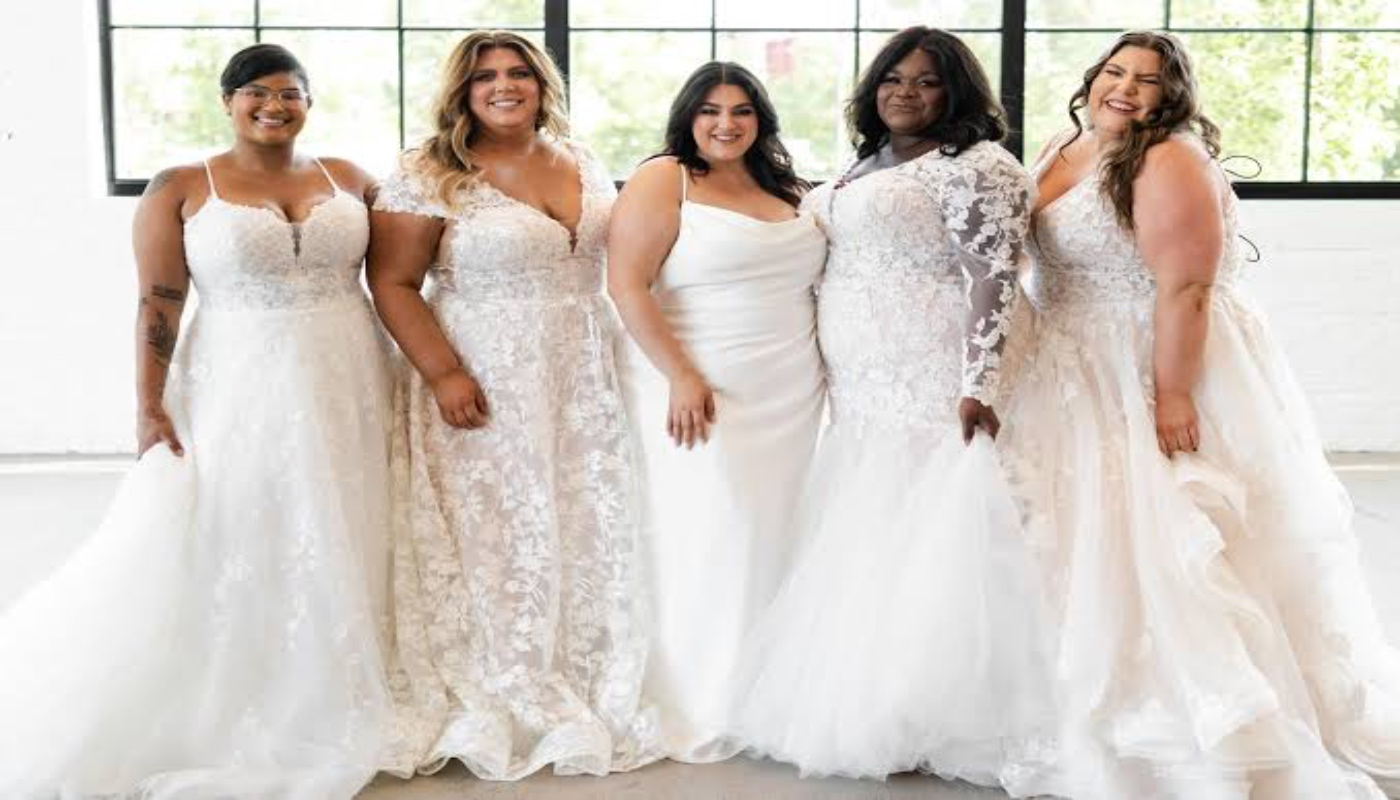
Designers are already demonstrating that extended sizing, thoughtful construction, diverse campaigns, and inclusive runway presentations can coexist with craftsmanship and commercial ambition.
The next stage requires the industry to move beyond isolated initiatives.
A size chart must be supported by garments that fit properly. A campaign must be supported by products customers can actually purchase. A boutique must offer an experience that respects the person entering it, regardless of her measurements.
South Asian bridal fashion, with its established relationship with custom tailoring and craftsmanship, has an especially meaningful opportunity to contribute to this transformation. Western luxury bridal houses, independent designers, and international retailers can also reconsider how they approach sample production and representation.
Ultimately, the wedding dress should reflect the person wearing it rather than an industry-defined ideal of who deserves to wear it.
A wedding is already filled with expectations, traditions, and emotional significance. The clothing chosen for that occasion should create possibilities, not introduce another standard that people feel pressured to meet.
The future of bridal fashion will not be defined simply by how many sizes designers print in their catalogues.
It will be defined by whether every bride can enter a boutique, find a garment that reflects her taste, experience a respectful fitting, and feel that the industry has considered her from the beginning.
Because inclusivity should not be an exception offered to certain brides.
It should be an ordinary part of what it means to create beautiful bridal fashion.
Sources: Vogue, The Knot, Los Angeles Times, Who What Wear, Stylist, Bridal Times, Modern Luxury, The Curvy Fashionista, Maggie Sottero, Bridal Collective