 by
by For generations, the acceptable male grooming routine in many societies could be summarized in a handful of actions: get a haircut, shave or trim the beard, use deodorant, perhaps wear cologne, and leave the bathroom before anyone noticed you had spent too much time there.
That script is changing.
Today, a man may discuss his cleanser with the same ease as his barber, know the difference between a hydrating serum and an exfoliating toner, maintain a multi-step hair routine, shape his eyebrows, experiment with nail polish, wear tinted products, invest in fragrance wardrobes, or book professional facial treatments. In South Korea, male cosmetics have become deeply integrated into everyday beauty culture. In India, younger men are increasingly driving interest in skincare and ingredient-led products. In Pakistan, men’s grooming has expanded beyond the traditional barber shop into salons and specialized personal-care services. Meanwhile, in Western markets, celebrity-founded beauty brands and social-media creators have helped make skincare, makeup, fragrance and nail products increasingly visible as part of men’s lifestyles.
But the most interesting part of this transformation is not the products themselves.
It is what those products reveal about masculinity.
Grooming has always been more than hygiene. Hair, facial hair, clothing, fragrance and bodily presentation communicate age, status, profession, religion, class, sexuality, confidence and belonging. What changes over time is which forms of presentation a culture permits men to claim without having their masculinity questioned.
The contemporary grooming boom therefore tells a larger story: masculinity is becoming less dependent on looking as though one does not care about appearance.
That does not mean older forms of masculinity have disappeared. Nor does every man who uses skincare understand his routine as a challenge to gender norms. In many cases, grooming has simply become another practical tool for looking professional, attractive or presentable.
Yet underneath that ordinary behavior is a significant cultural shift. Men are increasingly being given permission to care about how they look—and, in some environments, they are increasingly expected to.
That distinction matters.
From “Looking Good” to Admitting You Care About Looking Good
The history of men’s grooming is full of contradictions.
Men have never actually been strangers to appearance. Soldiers have polished shoes and maintained uniforms. Aristocrats have worn elaborate clothing and perfumes. Dandies turned personal presentation into an art form. Athletes have developed carefully maintained hairstyles and facial hair. Actors and musicians have routinely relied on professional makeup and hairstyling.
The cultural restriction was therefore never simply that men could not groom themselves.
It was that grooming had to be framed in the right language.
A man could be clean. He could smell good. He could have a sharp haircut. He could look youthful. He could even be fashionable.
But historically, excessive attention to beauty could be interpreted as vanity, softness or a failure to embody conventional masculinity.
Modern grooming culture is gradually changing that vocabulary.
Instead of “beauty,” products are often sold through words such as performance, protection, confidence, health, freshness, precision and maintenance. Academic research examining men’s skincare advertising has found that brands frequently combine beautification with traditionally masculine ideas, allowing cosmetics to be presented not as an abandonment of masculinity but as another method of maintaining it.
This is one of the most important developments in male grooming.
The industry did not necessarily convince men to stop being masculine.
It learned how to redefine grooming as masculine.
A cleanser becomes “skin maintenance.”
A moisturizer becomes “barrier protection.”
A beard oil becomes “beard care.”
A facial becomes “skin health.”
A fragrance becomes part of personal identity.
The vocabulary creates cultural permission.
The Beard Became a Cultural Symbol—Then a Grooming Project
Few grooming trends illustrate this transformation more clearly than the modern beard.
Facial hair has long carried meanings connected to adulthood, authority, religious identity, rebellion, ruggedness and masculinity. But the contemporary beard is increasingly treated as something that requires maintenance rather than simply something that grows.
Beard oils, balms, washes, combs, brushes, shaping tools and specialist trimming services have transformed facial hair into a grooming category of its own.
This is particularly visible in South Asia.
Pakistan provides an especially revealing example because men’s grooming sits at the intersection of tradition, religion, urbanization, global media and digital culture. Reporting on the country’s male salon boom has documented the expansion of services such as facials, manicures, massages and specialized styling, alongside a cultural shift in which some men increasingly viewed professional grooming as ordinary rather than embarrassing.
More recent market research also indicates that Pakistan’s men’s grooming category continues to expand beyond basic shaving, with beard care becoming an important part of urban and younger men’s personal-care routines.
The interesting point is not that Pakistani men suddenly became interested in appearance.
It is that appearance became easier to discuss publicly.
A beard can still symbolize conventional masculinity while requiring considerable aesthetic labor.
That contradiction is culturally significant.
The contemporary groomed beard says: I want to look masculine, and I am willing to work on that look.
The old stereotype suggested that masculinity should appear effortless.
The new grooming culture increasingly makes effort invisible—or makes the effort itself desirable.
Skincare Has Quietly Changed the Male Bathroom
Perhaps the biggest change has happened not at the salon but at home.
The male bathroom cabinet is becoming more complicated.
Cleanser. Moisturizer. Sunscreen. Beard products. Shampoo. Conditioner. Hair styling products. Eye products. Serums. Exfoliants. Fragrance.
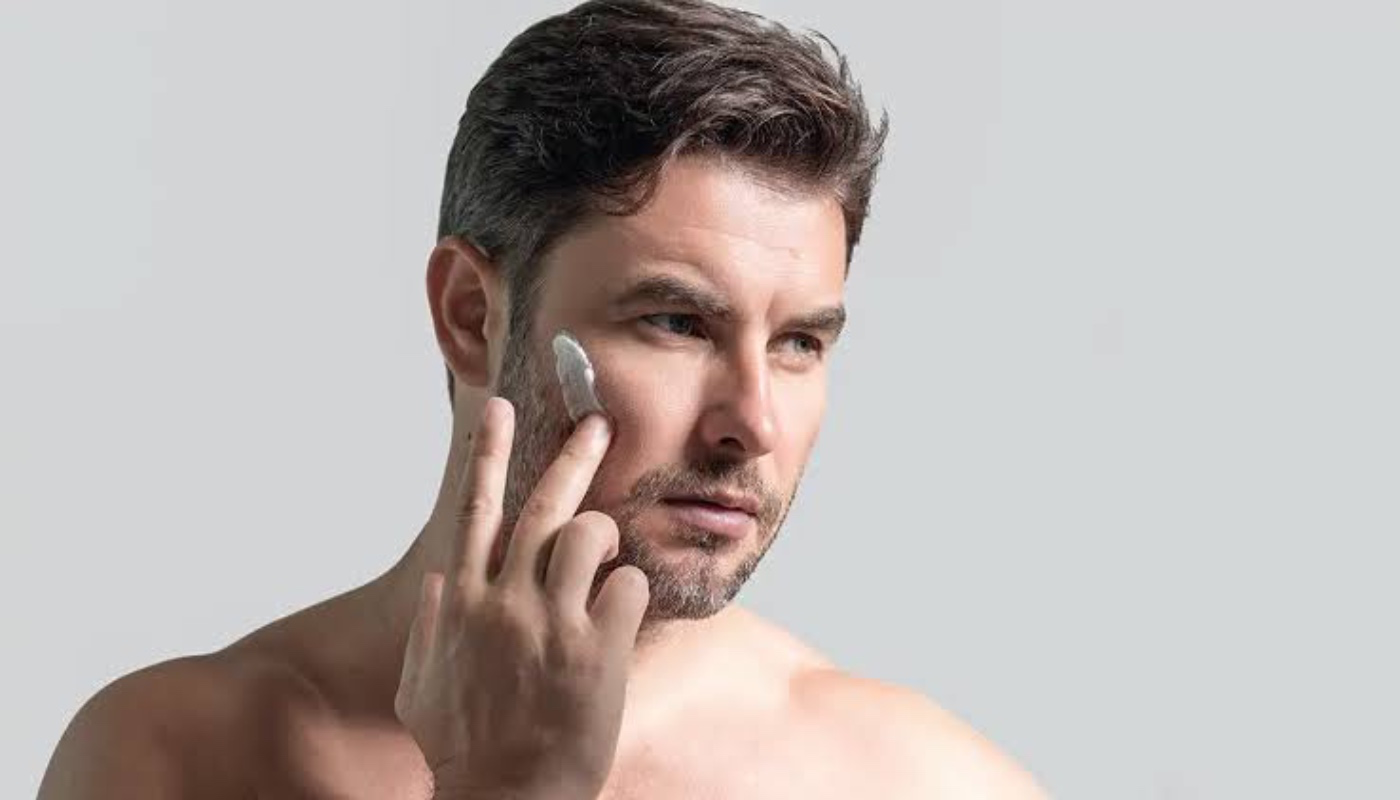
For some men, the routine remains minimal. For others, skincare has become a hobby, a form of self-care or an extension of beauty culture.
Research published in the Journal of Consumer Marketing in 2025 examined men’s skincare purchasing behavior and found that skin-health concerns significantly influence purchase intentions, while attitudes toward masculinity, self-image and social-media use also form part of the picture.
This is important because it challenges the simplistic idea that male skincare is merely the result of beauty companies “selling insecurity.”
There is certainly commercial pressure involved. Modern advertising can turn ordinary features of the face into problems requiring correction. Research on men’s skincare advertising has specifically found that male faces are often presented as surfaces that need improvement, while skincare is simultaneously connected to conventional masculine qualities such as control, competence and self-discipline.
But consumers can also approach skincare for practical reasons.
Sun protection is useful.
Dryness can be uncomfortable.
Acne can affect confidence.
Shaving can irritate skin.
Hair and beard maintenance can be enjoyable.
Taking ten minutes to care for yourself can simply feel good.
Male grooming becomes more inclusive when those motivations are allowed to coexist rather than being reduced to either vanity or necessity.
South Korea Shows That Masculinity Does Not Have One Global Formula
If Western societies sometimes treat male beauty as a relatively recent cultural development, South Korea complicates that narrative.
Korean beauty culture has played a major role in expanding the international understanding of what male grooming can look like.
K-pop idols have helped normalize polished hairstyles, carefully maintained skin, elaborate styling and makeup as part of male celebrity presentation. Research on young South Korean men has found that makeup practices are becoming integrated into contemporary masculinity through interactions with peers, family members and broader cultural influences, including the Korean Wave and changing ideas about self-care.
The cultural lesson is profound.
Makeup does not inherently have a gender.
Its gender meaning is assigned by society.
In one culture, foundation may be coded as feminine. In another, it may be treated as an ordinary part of professional or public presentation.
South Korean advertising has consequently developed male beauty imagery that does not simply copy Western ideas about masculinity. Research examining Korean cosmetics advertising has emphasized the cultural specificity of masculine identity and the importance of understanding how beauty practices acquire different meanings in different societies.
That makes South Korea particularly useful for understanding global masculinity.
The question is not whether men everywhere are becoming “more feminine.”
That framework assumes that skincare, cosmetics and aesthetic attention belong naturally to women.
A more accurate question is: Which grooming behaviors does each culture allow men to claim as masculine?
India: The Rise of the Ingredient-Conscious Groomer
India offers another revealing case study.
The country’s rapidly expanding beauty market has brought skincare into everyday conversations among younger consumers, including men. NielsenIQ’s 2025 research on Gen Z and male grooming in India identified growing interest among young men in skincare, ingredient-led products, hybrid beauty and self-expression, while also highlighting social media as an important influence on perceptions of beauty.
This represents a shift from the older model in which men’s grooming was heavily concentrated around shaving, deodorant and hair products.
The modern Indian male grooming consumer can encounter skincare through Instagram reels, YouTube tutorials, dermatology content, celebrity campaigns, e-commerce reviews and beauty creators.
The result is a new form of beauty literacy.
Men are not simply buying products.
They are learning the language surrounding products.
Ingredients become searchable.
Routines become shareable.
Before-and-after imagery becomes content.
Skin types become categories.
The bathroom becomes a space where knowledge, identity and consumption overlap.
Yet Indian masculinity also demonstrates that modernization does not erase older beauty ideals.
Research examining Indian men’s lifestyle advertising has identified the persistence of ideals involving muscularity, fairness, class and globalized appearance.
So the transformation is not necessarily from “traditional masculinity” to “liberated masculinity.”
Sometimes it is from one demanding masculine ideal to another.
The difference is that the contemporary ideal may require considerably more grooming.
Pakistan: Between Barber Culture and Beauty Culture
Pakistan provides perhaps one of the most fascinating examples of masculinity in transition because grooming practices can carry multiple meanings simultaneously.
A beard can be religious.
A haircut can be fashionable.
A fragrance can be traditional.
A facial can be considered self-care.
A carefully shaped beard can signal both cultural identity and contemporary style.
This coexistence means Pakistani men’s grooming cannot simply be explained through Western ideas such as “metrosexuality” or gender-fluid beauty.
Earlier reporting from Pakistan documented a growing market for male salons, driven partly by social media, urban lifestyles and increased exposure to international fashion and entertainment.
The evolution has continued through digital commerce and local grooming brands. Euromonitor’s current Pakistan market overview identifies men’s shaving as a major category while noting continued growth in fragrances and changing retail patterns, including the importance of digital channels.
What makes this culturally interesting is the way Pakistani men can incorporate new grooming practices without necessarily rejecting traditional masculinity.
A man can care deeply about his beard shape while also using skincare.
He can prefer a classic masculine fragrance while maintaining a detailed hair routine.
He can visit a salon without understanding the experience as a challenge to his gender identity.
Masculinity, in other words, is not being replaced.
It is being expanded.
Fragrance Is Becoming Part of Personal Identity
Grooming does not end at the skin.
Fragrance has become one of the most culturally powerful ways men construct identity.
Historically, men’s fragrances were often marketed through a narrow vocabulary: power, seduction, adventure, sport, virility, rebellion.
Contemporary fragrance marketing increasingly offers more varied emotional identities.
A man can want to smell clean.
Warm.
Sweet.
Woody.
Floral.
Smoky.
Citrusy.
Comforting.
Elegant.
There is no inherent reason these scent preferences should be gendered.
Yet fragrance remains one of the areas where gender coding is particularly visible because perfume bottles, advertising imagery and even scent descriptions are frequently divided into “men’s” and “women’s” categories.
The changing fragrance market therefore illustrates a broader cultural transition: consumers increasingly choose products according to the identity they want to express rather than simply the gender printed on the packaging.
This does not mean gendered fragrance categories will disappear.
They remain commercially useful and culturally familiar.
But the boundaries are becoming more porous.
Celebrity Grooming Has Made Male Beauty Visible
Celebrity culture has accelerated these changes because famous men can make grooming practices visible at enormous scale.
Harry Styles’ beauty venture Pleasing, for example, explicitly entered areas such as nail products and genderless beauty. His public fashion choices and the brand’s positioning contributed to a broader cultural conversation around men’s relationship with beauty and gender presentation.
Other high-profile men have also entered skincare and beauty entrepreneurship, including Pharrell Williams, Brad Pitt, Jared Leto and John Legend. Business of Fashion has documented the rise of male celebrity-founded beauty businesses as part of a wider blurring of conventional gender boundaries in beauty.
The significance is not simply that celebrities sell products.
It is that celebrity behavior changes the visual vocabulary available to audiences.
When a famous man appears in public wearing nail polish, visibly groomed skin or fashion traditionally coded as feminine, the image becomes part of mainstream visual culture.
It may still be controversial.
It may still attract debate.
But it becomes visible.
And visibility matters.
A behavior that exists only privately can remain socially stigmatized. A behavior repeatedly displayed by admired public figures becomes easier to imagine as part of ordinary life.
Social Media Has Turned Grooming Into Knowledge
The barber once controlled much of the information available to men about grooming.
Now the algorithm does.
TikTok, Instagram and YouTube have transformed grooming from something men receive as a service into something they can study.
A young man can learn how to shape a beard from one creator, understand sunscreen from another, discover fragrance layering from a third and copy a hairstyle from a celebrity within minutes.
This democratizes information.
It also creates new pressures.
Aesthetic culture can be liberating because it gives people more choices.
But more choices can also create more opportunities to feel inadequate.
Recent Pakistani commentary on “looksmaxxing,” for example, has highlighted the tension between self-improvement and increasingly relentless appearance monitoring among young men.
This is where the psychological implications of grooming become complicated.
A healthy grooming routine can support confidence and self-expression.
An obsessive pursuit of an idealized appearance can instead make the mirror feel like a scoreboard.
The distinction is not always obvious.
From Ruggedness to “Polished Masculinity”
One of the most significant shifts is the changing relationship between masculinity and effort.
The old rugged ideal often depended on appearing untouched by beauty culture.
Messy hair suggested spontaneity.
A rough beard suggested toughness.
Weathered skin could be associated with experience.
The contemporary polished ideal often works differently.
The hair should look effortless—but only after styling.
The beard should appear naturally full—but precisely shaped.
The skin should look healthy—but the routine behind it may involve several products.
The fragrance should seem natural—but it may have been carefully selected.
The result is a fascinating paradox:
Modern masculinity can demand enormous aesthetic labor while pretending that the result is effortless.
This is not unique to men. Women have long navigated similar expectations.
What is changing is that men are increasingly entering a system of appearance management that women have historically been expected to navigate more intensely.
That creates both opportunities and new pressures.
The Rise of “Soft Masculinity” Does Not Mean the End of Strength
The visual language of masculinity has expanded beyond toughness.
Men can be gentle.
Well-groomed.
Fashion-conscious.
Emotionally expressive.
Care-oriented.
Interested in fragrance.
Interested in skincare.
Interested in beauty.
None of these qualities inherently negate strength.
Recent research into men’s grooming advertising found that contemporary campaigns increasingly incorporate emotional openness, caregiving and greater fluidity alongside older masculine ideals.
That suggests masculinity is not necessarily moving from one fixed definition to another.
Instead, it may be becoming more plural.
A man can be muscular and skincare-conscious.
Traditional and fashionable.
Bearded and meticulous.
Soft-spoken and confident.
Interested in cosmetics without considering himself less masculine.
The coexistence of these identities is arguably more culturally significant than the disappearance of any single masculine archetype.
But Grooming Can Also Reinforce Masculine Privilege
A more inclusive grooming culture should not automatically be celebrated as progressive in every respect.
Research on men’s skincare advertising raises an important caution: beautification can become another form of “aesthetic labour,” in which individuals are encouraged to continually improve themselves through consumption.
For men, this can sometimes produce a new version of the old masculine ideal.
Instead of being told that a man should simply be tough, he may now be told that he should be tough, successful, youthful, muscular, well-dressed, well-groomed, professionally polished and photogenic.
The pressure has not necessarily disappeared.
It may simply have become more sophisticated.
There is also a gendered dimension to the expansion of male beauty.
When men enter beauty culture, they may receive praise for practices women have historically been expected to perform without recognition.
A man who takes care of his skin can be described as disciplined.
A woman performing similar routines may simply be considered normal.
This difference reveals how deeply gendered expectations continue to shape perceptions of grooming.
Grooming Is Also About Class
Not every grooming trend is equally accessible.
Professional facials, premium fragrances, dermatological treatments, specialist barbers, luxury skincare and high-end hair products can be expensive.
Even apparently simple routines depend on access to products, information and time.
Research on Indian men’s lifestyle advertising has connected contemporary masculine ideals with class and global consumer culture, demonstrating how appearance can become a marker of aspirational status.
This matters because the “well-groomed man” is not a culturally neutral image.
In many societies, grooming communicates that someone has the resources to invest in himself.
A perfectly shaped beard may signal access to a skilled barber.
A niche fragrance may signal disposable income.
A sophisticated skincare routine may signal education and digital beauty literacy.
A designer haircut may communicate professional or social status.
As grooming becomes more important, appearance can become another arena where class differences are visible.
The Workplace Is Part of the Transformation
Grooming also reflects changing expectations of professionalism.
In many industries, appearance has become increasingly visual.
Employees participate in video meetings.
Professionals maintain LinkedIn photographs.
Entrepreneurs build personal brands.
Influencers turn their faces into businesses.
Actors, athletes and corporate figures operate in image-driven environments.
Under these conditions, grooming can be interpreted as professional maintenance rather than vanity.
Research on South Korean men has shown how aesthetic practices can be linked to workplace interactions, perceived competence and social harmony.
This demonstrates an important point: grooming does not always challenge masculine norms.
Sometimes it helps men navigate them.
The groomed face can communicate reliability.
The polished hairstyle can communicate professionalism.
The carefully maintained appearance can become part of workplace credibility.
That is a different cultural function from beauty for beauty’s sake.
The Body-Positive Conversation Must Include Men Too
The expansion of male grooming raises an important question for body inclusivity.
If men are increasingly being invited into beauty culture, will they also be allowed to exist within it without having to achieve perfection?
This is crucial.
There is little cultural value in replacing one rigid masculine ideal with another.
If the old expectation was “real men don’t care about appearance,” the new expectation cannot become “real men must always look flawless.”
That would simply exchange neglect for surveillance.
A genuinely inclusive grooming culture would make room for men with different skin types, hair textures, ages, facial structures, body shapes, disabilities, cultural identities and aesthetic preferences.
It would recognize grooming as optional rather than mandatory.
It would allow a man to love skincare without requiring him to look like an influencer.
It would allow another man to own one bottle of shampoo and consider the routine complete.
It would allow beards and clean-shaven faces.
Gray hair and dyed hair.
Bare nails and painted nails.
Minimal routines and elaborate ones.
The cultural breakthrough is not getting every man to participate in beauty.
It is making participation less restrictive.
Men Are Also Redefining What “Self-Care” Means
The language of self-care has traditionally been associated strongly with women.
But men’s grooming is helping normalize another interpretation.
Self-care does not have to mean candles, spa days or elaborate rituals.
It can mean taking care of your skin after shaving.
Maintaining your hair because it makes you feel good.
Wearing a fragrance that creates a sense of identity.
Taking time to moisturize dry hands.
Getting a haircut before an important event.
Learning how to care for curly hair.
Finding a sunscreen that is comfortable enough to wear every day.
These behaviors are ordinary.
Their cultural significance comes from who has historically been encouraged—or discouraged—from performing them.
As men’s grooming becomes normalized, self-care becomes less tightly attached to femininity.
That is a meaningful cultural development.
The New Masculinity Is Not One Look
Perhaps the most important lesson from global grooming trends is that there is no single emerging male aesthetic.
South Korean beauty culture emphasizes polished skin and sophisticated cosmetics.
Indian Gen Z grooming increasingly emphasizes skincare, ingredients and digital discovery.
Pakistan combines beard culture, fragrance, barbering and expanding salon services.
Gulf grooming culture places considerable emphasis on precision, presentation and meticulously maintained facial hair.
Western celebrity culture has pushed gender-neutral beauty, nail products, skincare entrepreneurship and expressive fashion into mainstream conversations.
These cultures are influencing one another, but they are not becoming identical.
A Pakistani man’s grooming choices cannot automatically be interpreted through a Western framework.
A Korean man’s makeup use does not necessarily carry the same cultural meaning as a man’s makeup use in London or Los Angeles.
An Indian man’s skincare routine may reflect both global beauty culture and local ideas about complexion, class and presentation.
Culture determines meaning.
The product is only the starting point.
What Comes Next?
The next stage of male grooming may be less about convincing men to groom themselves and more about dismantling the idea that grooming has one correct masculine form.
Already, the market is moving toward multifunctional products, ingredient transparency, digital education and more expressive approaches to beauty. Research into India’s Gen Z male consumers points toward growing interest in performance-led, inclusive and locally relevant grooming products, while broader men’s grooming research shows continued expansion across skincare, haircare, fragrance and personal-care categories.
But the most important evolution may happen outside the marketplace.
It may happen in ordinary conversations.
When a father teaches his son how to use moisturizer.
When friends exchange fragrance recommendations without embarrassment.
When a man asks a dermatologist about his skin.
When a teenager learns that sunscreen is not “for girls.”
When someone realizes that caring about his appearance does not require apologizing for it.
And equally importantly, when someone who does not enjoy grooming is not mocked for that either.
That is where masculinity becomes genuinely flexible.
Conclusion: The Mirror Is Changing, but So Is the Man Looking Into It
Male grooming trends are often discussed as though they are simply about vanity, fashion or the expansion of the beauty industry.
They are much more revealing than that.
They show how societies decide what men are allowed to care about.
For decades, masculinity was often constructed around the appearance of emotional and aesthetic indifference. A man could look good, but ideally he should not appear to be trying too hard.
Today, that expectation is loosening.
Men are increasingly able to acknowledge effort.
They can moisturize.
Style.
Experiment.
Smell distinctive.
Care for their hair.
Maintain their beards.
Wear makeup.
Paint their nails.
Or simply develop a grooming routine that makes them feel comfortable in their own skin.
Yet progress should not be confused with a new demand for perfection.
The future of male grooming should not be a world in which every man is pressured to become an immaculate, algorithm-approved version of masculinity.
It should be a world in which grooming becomes a choice rather than a gender test.
That distinction is especially important for body inclusivity.
The real cultural shift is not that men are becoming more beautiful.
Men have always been capable of beauty.
The shift is that beauty, care and self-presentation are increasingly being recognized as human behaviors rather than inherently feminine ones.
Masculinity is not disappearing from the grooming mirror.
It is becoming more complicated.
And perhaps that complexity is the most valuable change of all.
Because a healthier definition of masculinity does not require men to stop being traditionally masculine. It simply gives them more room to decide what masculinity means to them.
The beard can stay.
The skincare can stay.
The fragrance can stay.
The nail polish can stay.
The five-minute routine can stay too.
What matters is that none of these choices has to determine whether someone is “man enough.”
The future of male grooming is therefore not necessarily about men looking more feminine, more masculine, or even more fashionable.
It is about men having greater freedom to participate in their own appearance without having their identity reduced to it.
And when grooming becomes a form of choice rather than a test of masculinity, the mirror stops being a judge.
It becomes what it should have been all along: simply a place to see yourself.
Sources: NielsenIQ, Journal of Consumer Marketing, The Guardian, Vogue, Esquire, Business of Fashion, The New York Times, Sage Journals, ScienceDirect, PubMed, Galactica Media, Dawn, The National, Euromonitor International, GQ Middle East